
What’s the Market Demand for Aluminum Extrusions in 5G Base Stations?
- By:SJHM
- Date:07-08-2025
In 2025, China’s total number of 5G base stations exceeded 3.8 million, accounting for over 60% of the global total; global 5G users surpassed 1.8 billion, with a penetration rate exceeding 25%. This communication revolution driven by 5G is reshaping digital infrastructure at an astonishing pace. Behind every 5G base station, industrial aluminum extrusions—serving as core structural materials—are stepping out of the “backstage” and into the “spotlight,” becoming the “invisible backbone” supporting the efficient operation of 5G networks.
As a manufacturer with 19 years of expertise in industrial aluminum extrusions, we have deeply participated in 5G base station construction projects for China’s three major telecom operators. This article breaks down the market opportunities for aluminum extrusions in 5G base stations and strategies for manufacturers to stand out, covering four key dimensions: industry trends, technical requirements, manufacturer advantages, and collaboration cases.
I. The 5G Base Station Construction Boom: A “Demand Storm” for Industrial Aluminum Extrusions
1.1 Global 5G Base Station Deployment Progress
According to the latest report from GSMA (Global System for Mobile Communications Association), the global total of 5G base stations will reach 6.5 million in 2025, with China accounting for over 60% (approximately 3.9 million units). Annual new installations will stabilize at 600,000–800,000 units. The high-density deployment of 5G base stations has directly driven a surge in aluminum demand for base stations. In 2023, China’s aluminum consumption for 5G base stations exceeded 2.1 million tons, accounting for 65% of the global total.
1.2 Why Aluminum Extrusions Are the “Preferred Material” for 5G Base Stations?
Compared to traditional steel or plastic, industrial aluminum extrusions offer significant advantages in 5G base stations, perfectly matching the core requirements of “lightweight, high thermal conductivity, corrosion resistance, and easy processing”:
- Lightweight: With a density of only 2.7g/cm³ (1/3 that of steel), single-base-station tower weight is reduced by 60%, cutting transportation/installation costs by over 30%.
- High Thermal Conductivity: 237W/(m·K) (8x that of steel), efficiently dissipating heat from antennas/power amplifiers (5G devices consume 50% more power than 4G).
- Corrosion Resistance: A natural alumina protective film (0.01–0.1mm thick) resists salt and moisture, extending maintenance cycles to over 10 years.
- High Processability: Customizable complex structures (e.g., antenna brackets, heat sinks) via extrusion, stamping, or welding, with dimensional tolerances ≤0.1mm, reducing manufacturing cycles by 20% and accelerating base station construction.
Conclusion: The 5G base station’s demand for “high-performance + customized” materials makes industrial aluminum extrusions an irreplaceable core choice.
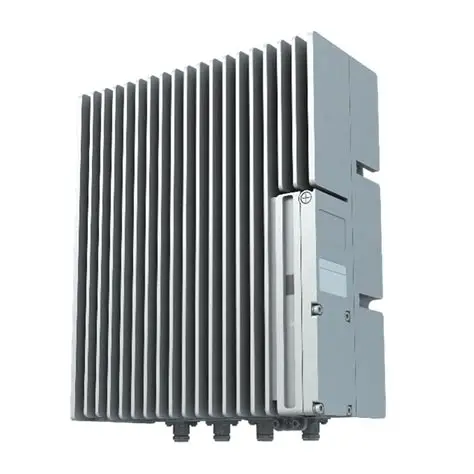
II. Key Application Scenarios of Aluminum Extrusions in 5G Base Stations
A 5G base station comprises an antenna system (AAU), radio frequency unit (RRU), power module, cabinet/tower, and other components. Aluminum extrusions play critical roles in these areas:
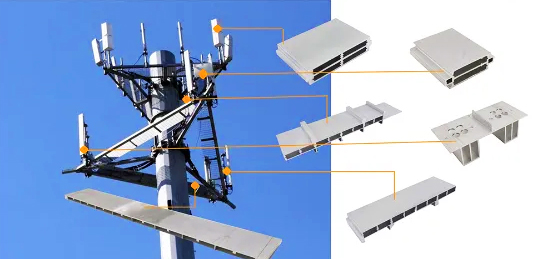
1. Structural Support for Antennas and RF Units
- Antenna Covers/Housings: 5G antennas (especially Massive MIMO antennas) require lightweight, wind-resistant, and electromagnetically transparent designs. Aluminum extrusions (e.g., 6063-T5) are extruded into complex cross-sectional frames to support antenna arrays. Their low density (≈2.7g/cm³) significantly reduces antenna weight (over 50% lighter than steel structures), simplifying tower installation and maintenance.
- RF Unit (RRU) Housings: RRUs handle signal transmission, reception, and power amplification, generating high heat (up to 100W+). Aluminum extrusions’ high thermal conductivity (≈200W/(m·K)) aids heat dissipation, while their mechanical strength meets outdoor protection needs (dustproof, waterproof, vibration-resistant).
2. Critical Components of Cooling Systems
5G base stations consume 2–3x more power than 4G (3–5kW per station), making efficient cooling critical for device stability. Aluminum extrusions are widely used here:
- Heat Sinks/Fins: High-density fin structures extruded or die-cast to increase heat dissipation area, paired with fans or liquid cooling systems for rapid heat removal.
- Heat Pipe/Vapor Chamber Bases: Aluminum extrusions serve as supports for heat pipe evaporators/condensers or are directly processed into vapor chambers to enhance heat spreading efficiency.
3. Structural Components for Cabinets and Towers
- Outdoor Cabinet Frames: 5G cabinets house core devices like power supplies and BBUs (baseband processing units). Aluminum extrusions (e.g., 6061-T6) enable rapid assembly of lightweight, high-strength cabinet frames via modular splicing, with enhanced electromagnetic shielding (via anodized surface treatment).
- Tower Fasteners and Connectors: Components like bolts, rails, and clamps for base station towers or poles are often made from aluminum extrusions. Their corrosion resistance adapts to humid, salt-spray environments, reducing maintenance costs.
Material Selection Guidance:
- For high-strength structural components (e.g., tower connectors), prioritize 6061-T6.
- For high thermal conductivity and easy-forming cooling parts, choose 6063-T5.
- For electromagnetic shielding-sensitive areas (e.g., inside RRUs), use 1060 pure aluminum or copper-plated aluminum extrusions.
III. Four Core Technical Requirements for Aluminum Extrusions in 5G Base Stations
The device architecture of 5G base stations (antenna systems, power modules, thermal management, tower structures) dictates specific application scenarios for aluminum extrusions. To gain a competitive edge, manufacturers must precisely match “material + process” requirements for each scenario.
2.1 Antenna Systems: Lightweight + High-Precision Components
5G adopts Massive MIMO (Multiple-Input Multiple-Output) technology, with single-panel antennas containing 64/128 channels. Antenna weight has increased from 50kg (4G) to over 200kg. Aluminum extrusion demands in antenna systems focus on:
- Structural Components: Antenna reflectors (6063-T5 aluminum alloy) and brackets (6061-T6 aluminum alloy), requiring “high flatness + low deformation.”
- Cooling Components: Antenna RF module heat sinks (3003 aluminum alloy), needing high thermal conductivity + anodized surface treatment.
2.2 Power and Cooling Systems: High Thermal Conductivity + Electrical Conductivity
Power modules (switching power supplies, UPS) and power amplifiers (PAs) account for 40% of total base station energy consumption, creating urgent cooling needs. Aluminum extrusions are used here for:
- Heat Sinks: Finned heat sinks for PA modules, requiring high thermal conductivity + large surface area.
- Conductive Components: Power busbars (6061 aluminum alloy).
2.3 Thermal Management Systems: Surging Demand for Liquid Cooling and Vapor Chambers
5G PA efficiency is only 50%, with the remaining 50% converted to heat—local temperatures can exceed 80°C (vs. 60°C for 4G). Emerging thermal management systems like liquid cooling and vapor chambers demand advanced aluminum extrusions:
- Liquid Cooling Plates: Aluminum alloys (3003/6061) with high sealing performance + corrosion resistance; vapor chambers: high-conductivity aluminum alloys (6063) ensure uniform heat distribution and improved cooling efficiency. Aluminum extrusions here require excellent weldability and high-temperature resistance to meet complex process needs.
- Vapor Chambers: Ultra-thin aluminum substrates, demanding high thermal conductivity uniformity + vacuum brazing processes.
2.4 Towers and Supporting Facilities: Lightweight + Weather Resistance Upgrades
Traditional steel towers are heavy, costly to transport, and prone to rust in humid/coastal areas. Aluminum alloy towers (6063-T5) are rapidly replacing steel towers due to their lightweight (60% lighter than steel) and low-maintenance advantages:
- Tower Main Structure: Large-section aluminum extrusions requiring high load-bearing capacity (tensile strength ≥180MPa) + wind resistance.
- Connecting Components: Aluminum bolts, clamps (6061-T6) with high strength + fatigue resistance (for cyclic loading).
IV. Development Trends
As 5G evolves toward higher frequencies (millimeter-wave) and greater capacity (ultra-dense networking), aluminum extrusion applications will further optimize:
1. High-Strength Lightweighting
Develop alloy/nano-strengthened aluminum alloys to enhance strength while reducing weight further.
2. Multi-Functional Integration
Achieve multi-performance synergy in single extrusions through surface microstructures (e.g., bio-inspired heat dissipation textures) or composite coatings (thermal + electrical + anti-corrosion).
3. Intelligent Manufacturing
Use 3D-printed aluminum extrusions to create complex cooling structures (e.g., conformal cooling channels), shortening 5G base station R&D cycles.
4. Global “Dual Carbon” Policy: Accelerated Aluminum Tower Adoption
The EU’s “Fit for 55” plan mandates a 45% reduction in communications industry carbon emissions by 2030 vs. 2020. Aluminum alloy towers (lightweight + low transportation energy) have become a necessity. From 2025–2030, annual aluminum consumption for overseas aluminum towers is projected to grow by 15%. Their widespread adoption aligns with environmental trends, reduces O&M costs, and improves base station construction efficiency. As global 5G networks expand, aluminum material demand will continue to rise, driving collaborative development across the industrial chain and supporting green transformation in communications.
The future of aluminum extrusions in 5G base stations is promising. Their lightweight, high thermal conductivity, and corrosion resistance perfectly meet 5G devices’ needs for efficient cooling and sustainability. With technological advancements and cost optimization, aluminum materials will see broader application in base station construction, driving the communications industry toward low-carbon, high-efficiency development and new heights in global 5G network deployment.
Learn more :https://www.sjhmalu.com/
Custom Aluminum Extrusions & Profiles Manufacturer
Profile Custom Extrusions
Custom Aluminum Extrusions Service
Profile Precision Extrusions
Custom aluminum extrusions
Aluminum extrusion manufacturers in USA
decorative aluminum
Aluminum bracket
uchannel aluminum
extruded aluminum heatsink
aluminum components
aluminum housing
battery shell
aluminium and aluminium,aluminum manufacturers,aluminum fabrication,aluminum company
product manufacturing,aluminium al 6061,aluminum alloy 6063,2024aluminum ,aluminum alloy,aluminum profiles