
7075 Aluminum: What You Need to Know About Its Heat Treatment Processes?
- By:SJHM
- Date:30-07-2025
7075 Aluminum: What You Need to Know About Its Heat Treatment Processes?
Why Does 7075 Aluminum Deserve Your Attention?
In the competitive world of industrial aluminum alloys, 7075 aluminum stands out as a “super-alloy” for high-stress applications. From aerospace components to high-performance machinery, its exceptional strength-to-weight ratio has made it a go-to material for engineers. But here’s the catch: without proper heat treatment, 7075 aluminum can’t reach its full potential.
If you’re an industrial aluminum profile manufacturer or a buyer sourcing materials for critical applications, understanding 7075 aluminum’s heat treatment processes isn’t just technical—it’s strategic. This guide dives deep into why heat treatment matters, the science behind it, and how it transforms 7075 aluminum into a material that meets (and exceeds) industry demands.
What is 7075 Aluminum? A Quick Refresher
7075 aluminum is a high-strength alloy belonging to the “7xxx series,” known for its zinc (Zn) as the primary alloying element (typically 5.6–6.1%), along with magnesium (Mg) and copper (Cu). This unique composition gives it:
- Exceptional tensile strength (up to 83,000 psi in T6 temper—comparable to some steels).
- Lightweight properties (density ~2.81 g/cm³, ~35% lighter than steel).
- Good corrosion resistance (though less than 5xxx series, improved with anodizing).
But raw 7075 aluminum isn’t ready for heavy-duty use. Its alloying elements form coarse, unaligned structures that limit performance. That’s where heat treatment steps in.
Why is Heat Treatment Critical for 7075 Aluminum?
Heat treatment isn’t just about “strengthening” metal—it’s about rearranging its atomic structure to unlock hidden properties. For 7075 aluminum, the process targets three key goals:
- Dissolve alloying elements into a uniform “solid solution” (like dissolving sugar in water).
- Precipitate fine particles that block dislocations (the main cause of metal deformation).
- Relieve internal stresses from manufacturing (e.g., rolling, cutting) to prevent warping.
Without these steps, 7075 aluminum would be brittle, prone to cracking, and unable to handle the stresses of aerospace or automotive applications.
The Science Behind 7075 Aluminum Heat Treatment: Microstructures Matter
To understand heat treatment, think of 7075 aluminum as a “team” of atoms. In its raw state, alloying elements (Zn, Mg, Cu) cluster together in large, uneven groups. These clusters weaken the metal by creating weak points.
Heat treatment disrupts these clusters:
- Heating (solution treatment): At ~482°C (900°F), the metal becomes a homogenous “soup” where alloying elements dissolve evenly.
- Quenching: Rapid cooling “freezes” this uniform structure, trapping alloying elements in a supersaturated solution.
- Aging: Reheating to ~121–163°C (250–325°F) causes fine particles (precipitates) to form. These particles act like “roadblocks,” stopping dislocations from moving—and thus, strengthening the metal.
This process, called precipitation hardening, is what turns 7075 aluminum into a material that can withstand extreme loads without deforming.
Common Heat Treatment Processes for 7075 Aluminum: Step-by-Step Breakdown
1. Solution Heat Treatment: The Foundation of Strength
Process: Heat 7075 aluminum to 460–482°C (860–900°F) and hold for 6–24 hours (depending on thickness) to dissolve alloying elements. Rapidly cool (quench) in water or polymer solutions to “freeze” the structure.
Purpose:
- Eliminate coarse alloy clusters, creating a uniform solid solution.
- Prepare the metal for aging by maximizing the amount of dissolved elements available to form precipitates.
Key Parameters:
- Temperature: Too low → incomplete dissolution; too high → melting risk.
- Quench rate: Slow cooling (e.g., air) reduces strength; rapid cooling (water) locks in the desired structure.
Outcome: A “soft” but uniform material ready for aging to gain maximum strength.
2. Precipitation Heat Treatment (Aging): The Strength Multiplier
Process: Reheat the solution-treated 7075 aluminum to 121–163°C (250–325°F) for 6–24 hours (longer for thicker sections). Cool naturally afterward.
Purpose:
- Trigger the formation of nanoscale precipitates (e.g., η-phase MgZn₂) that impede dislocation movement.
- Balance strength and toughness: Over-aging reduces strength but improves ductility.
Types of Aging:
- Natural Aging: Occurs at room temperature (slow, limited strengthening).
- Artificial Aging: Controlled reheating (fast, maximum strength—critical for T6 temper).
Outcome: A material with 2–3x higher yield strength than non-aged 7075 aluminum.
3. Stress Relieving: The Precision Enhancer
Process: Heat 7075 aluminum to 100–150°C (212–302°F) for 1–3 hours, then cool slowly (air or furnace).
Purpose:
- Reduce residual stresses from cold working, welding, or solution treatment.
- Prevent distortion during machining or assembly.
When is it Used?:
- For components requiring tight tolerances (e.g., aircraft fittings, engine mounts).
- To improve dimensional stability in high-vibration environments.
Outcome: A more stable, machinable material with minimal risk of warping post-processing.
7075 T6: The Gold Standard of Heat-Treated 7075 Aluminum
The most iconic variant of 7075 aluminum is the T6 temper, which combines solution heat treatment + artificial aging. Let’s break down why it’s so popular:
Properties of 7075 T6 Aluminum
- Yield Strength: ~73,000 psi (499 MPa)—stronger than most steels relative to its weight.
- Tensile Strength: ~83,000 psi (572 MPa)—resists breaking under extreme loads.
- Hardness: ~150 HB (Brinell)—resists scratches and abrasion.
- Density: 2.81 g/cm³—35% lighter than steel, critical for fuel efficiency in aerospace.
Advantages of T6 Tempering
- Balanced Performance: High strength and good machinability (unlike some ultra-hard alloys that are brittle).
- Corrosion Resistance: While not as corrosion-resistant as 6061 aluminum, T6 7075 can be anodized for enhanced protection.
- Weldability (with Caution): Welding T6 7075 requires pre- and post-heat treatment to avoid cracking—best suited for specialized fabricators.
Applications of 7075 T6 Aluminum
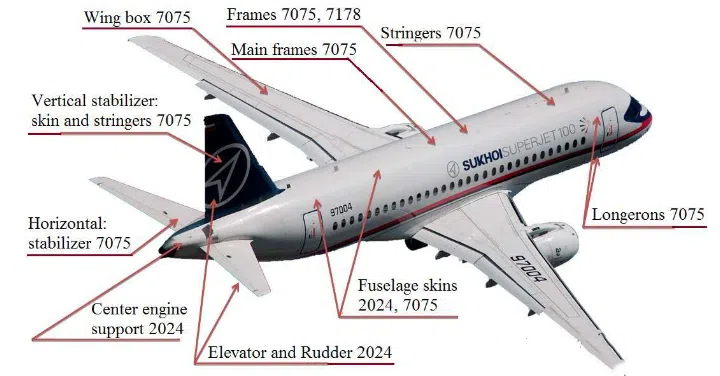
- Aerospace: Aircraft wings, landing gear, and engine components (where strength-to-weight ratio is non-negotiable).
- Automotive: High-performance suspension systems, driveshafts, and racing engine blocks.
- Defense: Military aircraft frames, weapon mounts, and armored vehicle components.
- Industrial: Heavy-duty machinery frames, robotics end-effectors, and high-load connectors.
7075 Aluminum in Action: Which Industries Rely on It?
Aerospace: Where Every Gram Counts
Aircraft manufacturers prioritize 7075 T6 for critical structural parts because:
- Reducing weight by 1 kg (2.2 lbs) can save $3,000+ in fuel costs over an aircraft’s lifetime.
- 7075 T6’s fatigue resistance (ability to withstand repeated stress) extends component lifespan by 20–30%.
Example: Boeing and Airbus use 7075 T6 for wing spars and fuselage frames, where failure isn’t an option.
Automotive: Performance Meets Efficiency
In the EV and sports car markets, 7075 T6 is used for:
- Suspension arms: Lightweight yet strong enough to handle cornering forces.
- Driveshafts: Reduces rotational mass, improving acceleration and torque.
Fun Fact: The Porsche 911 GT3 RS uses 7075 aluminum in its rear subframe to shave 11 lbs (5 kg) off the car’s weight.
Marine: Battling Saltwater Corrosion
Saltwater is brutal on metals, but 7075 T6 (with anodizing) thrives here:
- Boat hulls: Lightweight hulls improve speed and fuel efficiency.
- Marine hardware: Cleats, winches, and railings resist pitting and corrosion.
Case Study: A leading yacht manufacturer switched to 7075 T6 for its windlasses, reducing maintenance costs by 40% annually.
Military & Defense: Durability Under Fire
Military applications demand materials that can take a hit. 7075 T6 is used in:
- Vehicle armor: Lightweight but strong enough to stop small-arms fire.
- Ammunition casings: Withstands high internal pressures without deformation.
Testimonial: The U.S. Army reports that 7075 T6 components in armored vehicles show 50% less wear than legacy steel parts.
FAQs About 7075 Aluminum Heat Treatment
Q1: Can 7075 aluminum be heat-treated more than once?
Yes, but it’s tricky. Re-solution treating and aging can restore some properties, but repeated cycles may reduce ductility. Consult a metallurgist for specific applications.
Q2: What’s the difference between T6 and T7 temper in 7075 aluminum?
T6 uses artificial aging to maximize strength, while T7 uses over-aging to improve dimensional stability and thermal resistance (ideal for high-temperature environments).
Q3: How does heat treatment affect 7075 aluminum’s weldability?
T6 7075 is prone to cracking during welding due to residual stresses. Solution treating before welding (and re-aging afterward) mitigates this risk.
Q4: Is 7075 aluminum heat treatment eco-friendly?
Modern processes use closed-loop quenching systems to recycle water, and controlled atmospheres reduce emissions. Always work with certified suppliers for green compliance.
Q5: How do I choose between 7075 and 6061 aluminum for my project?
6061 is more weldable and corrosion-resistant (better for structural frames), while 7075 excels in high-stress, weight-sensitive roles (e.g., aerospace).
Conclusion: Why 7075 Aluminum Heat Treatment Matters for Your Business
7075 aluminum isn’t just another alloy—it’s a cornerstone of modern engineering. By mastering its heat treatment processes, you unlock:
- Unmatched strength for critical applications.
- Lightweight solutions that boost efficiency and reduce costs.
- Durability that outperforms competing materials.
As an industrial aluminum profile manufacturer, offering 7075 T6 aluminum profiles (or custom heat-treated variants) positions you as a leader in high-performance materials. Whether your clients are in aerospace, automotive, or defense, 7075 aluminum delivers the reliability and innovation they need to stay ahead.
Ready to leverage 7075 aluminum for your next project? Partner with a trusted manufacturer who understands the science—and the art—of heat treatment.
Learn more :http://www.sjhmalu.com
Custom Aluminum Extrusions & Profiles Manufacturer
Profile Custom Extrusions
Custom Aluminum Extrusions Service
Profile Precision Extrusions
Custom aluminum extrusions
Aluminum extrusion manufacturers in USA
decorative aluminum
Aluminum bracket
uchannel aluminum
extruded aluminum heatsink
aluminum components
aluminum housing