
Do you know the applications of railway vehicle aluminum profiles?
- By:SJHM
- Date:02-09-2025
As global rail transportation rapidly advances towards high-speed, lightweight, intelligent, and green development, industrial aluminum profiles have become the core material enabling this transformation, thanks to their irreplaceable performance advantages.
Railway Vehicle Aluminum Profiles
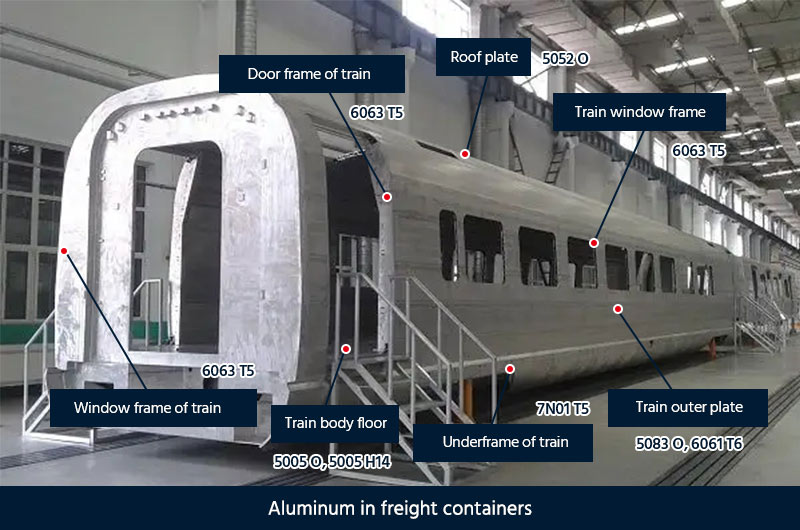
The “Lightweight Revolution” in Rail Transit and the Rise of Aluminum Profiles
Railway Vehicle Aluminum Profiles
Rail transit is the artery of modern cities, and its development level is a crucial benchmark for a nation’s manufacturing prowess. Against the global backdrop of “carbon neutrality” goals, reducing operating energy consumption and enhancing operational efficiency have become industry consensus. One of the key pathways to achieving this is body lightweighting.
Studies show that for every 10% reduction in body weight, traction energy consumption can be decreased by approximately 6-8%. Aluminum alloy, particularly industrial aluminum profiles manufactured through processes like extrusion and rolling, has completely replaced traditional carbon steel materials for building high-speed trains, subways, light rail, maglev trains, and railway carriages. This is due to its excellent strength-to-weight ratio (specific strength), superior corrosion resistance, outstanding machinability, good weldability, and 100% recyclability, making it the ideal choice.
As an industrial aluminum profiles manufacturer, we are not just a material supplier but a partner deeply involved in our clients’ design phases, offering end-to-end solutions from material selection, mold design, profile extrusion, to precision machining. Let’s explore the sophisticated applications of aluminum profiles in railway vehicles.
I. Train Front-End: The Perfect Fusion of Aerodynamics and Safety
Railway Vehicle Aluminum Profiles
The train front-end, particularly the streamlined “nose cone” of high-speed trains, is the iconic part of the entire train. It directly determines the aerodynamic performance and safety during operation.
1. Materials and Manufacturing Processes:
- High-Grade Aluminum Alloys: Typically, 6000 series (e.g., 6082, 6061, 6N01) and 7000 series (e.g., 7005, 7N01) aluminum alloys are selected. These alloys can achieve extremely high strength through heat treatment (T5, T6 tempers), meeting the wind pressure loads and vibration requirements of high-speed operation.
- Large-Scale Extrusion and Precision Machining: The front-end skeleton is constructed from large, complex-section aluminum profiles joined via high-precision welding techniques like MIG Welding and FSW (Friction Stir Welding), ensuring weld strength matches the base material. The outer skin uses high-strength aluminum alloy sheets, formed into complex 3D curves through stamping.
- Integrated Casting Technology: Cutting-edge technology now employs large aluminum alloy castings to manufacture more complex joints and structural parts, significantly reducing the number of components and welds, thereby enhancing overall rigidity and consistency.
Railway Vehicle Aluminum Profiles
2. Core Advantages:
- Ultimate Lightweighting: An aluminum front-end is over 50% lighter than a steel structure, significantly reducing axle weight and laying the foundation for high-speed operation.
- Exceptional Aerodynamic Performance: Aluminum alloy is easily processed into smooth, continuous, aerodynamic complex curves, effectively reducing air resistance (by over 20%) and the “micro-pressure wave” effect when passing through tunnels, improving ride comfort.
- Passive Safety Protection: Aluminum alloy has good energy absorption characteristics. In a collision, a well-designed aluminum front-end structure can absorb impact energy through controlled crumple zones, creating a “survival space” to maximize protection for the driver and passengers, meeting stringent crash standards like EN 15227.
Railway Vehicle Aluminum Profiles
II. Floor and Roof Systems: The “Backbone” and “Dome” Bearing the Entire Vehicle
The floor and roof systems are the core load-bearing parts of the body structure, akin to the human skeleton, requiring extremely high stiffness, strength, and functionality.
Railway Vehicle Aluminum Profiles
1. Floor System:
- Technical Core: Modern railway vehicle floors are no longer simple flat plates but highly integrated functional modules.
- Aluminum Honeycomb Sandwich Floor: Composed of upper and lower layers of high-strength aluminum alloy sheets (skins) bonded to an aluminum honeycomb core under high temperature and pressure. This structure offers extremely high specific stiffness and specific strength, is very lightweight, and provides excellent sound insulation, thermal insulation, and vibration damping, offering passengers a quiet and comfortable environment.
- Hollow Extruded Profile Floor: Another mainstream solution uses large, multi-chamber aluminum alloy extruded profiles welded together longitudinally. Their hollow chambers are natural “raceways” for laying extensive power, communication cables, and brake air pipes, achieving perfect unity of structure and function while facilitating maintenance.
2. Roof System:
- Technical Core: The roof must support equipment weight, wind pressure, snow loads, and provide a stable base for pantograph power collection.
- ”Saddle-Shaped” Large Hollow Profiles: The roof is formed by longitudinally welding several ultra-long (up to the full vehicle length), wide-width (over 600mm), thin-walled, reinforced aluminum extruded profiles. The cross-section is typically designed as an arch (saddle shape) to maximize structural strength and stability.
- Integrated Design: Features like mounting bases, drainage channels, and cable conduits can be directly extruded into the profiles, reducing subsequent machining and assembly processes. The entire roof system is lightweight, offers good sealing (crucial for high-speed trains with airtightness requirements), and easily integrates air conditioning units, pantographs, antennas, and other equipment.
III. Vehicle Sidewalls: A Paradigm of Modern Modular Manufacturing
1. Revolutionary Manufacturing Process – Large Hollow Extruded Profiles:
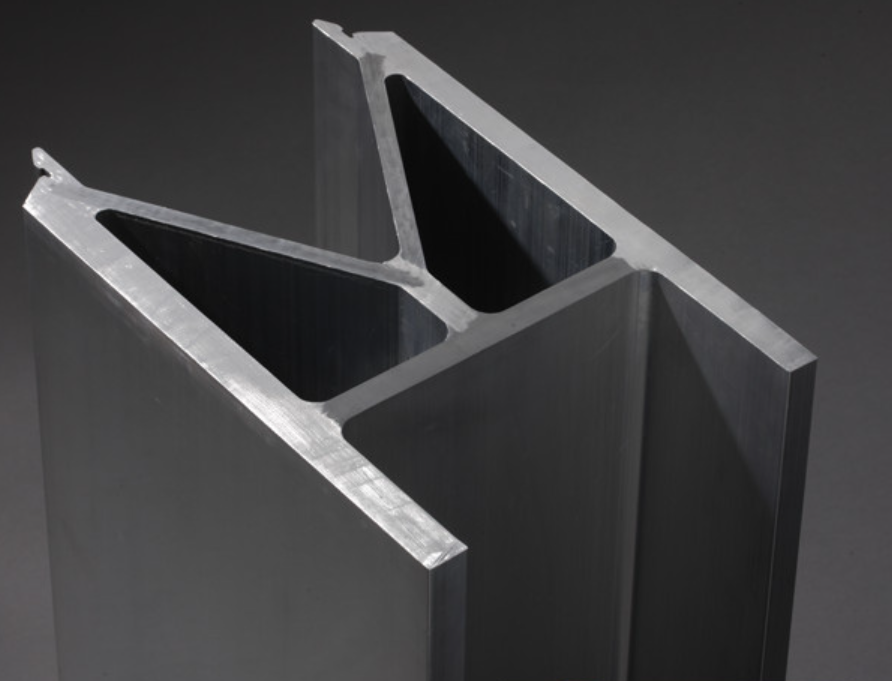
Traditional steel car body sidewalls were made from hundreds of small parts welded together, resulting in numerous welds, significant deformation, and low production efficiency. Modern aluminum car bodies use full-aluminum extruded profile modular technology.
- Uses single ultra-wide (up to 600-800mm), hollow aluminum alloy extruded profiles with lengths equivalent to the vehicle sidewall (20-30 meters).
- The entire sidewall requires only 2-4 such profiles welded longitudinally, reducing the number of welds by over 70%!
- The profiles themselves integrate functions like the frame, skin, interior mounting seats, and window installation frames.
2. Significant Advantages:
- High Production Efficiency and Consistency: Dramatically reduces welding work and subsequent shaping processes, shortens production cycles, and ensures more stable quality.
- Exceptional Structural Performance: The hollow multi-chamber design provides extremely high bending and torsional stiffness, ensuring vehicle stability during operation.
- Excellent Surface Quality: Extruded profiles have a smooth, flat surface, are easy to paint, and result in a luxurious final appearance.
- The Pinnacle of Lightweighting: Achieves maximum weight reduction while guaranteeing strength and stiffness.
IV. Other Key Aluminum Components: Ubiquitous Lightweighting Solutions
The application of aluminum profiles extends far beyond large structures, permeating every corner of the vehicle.
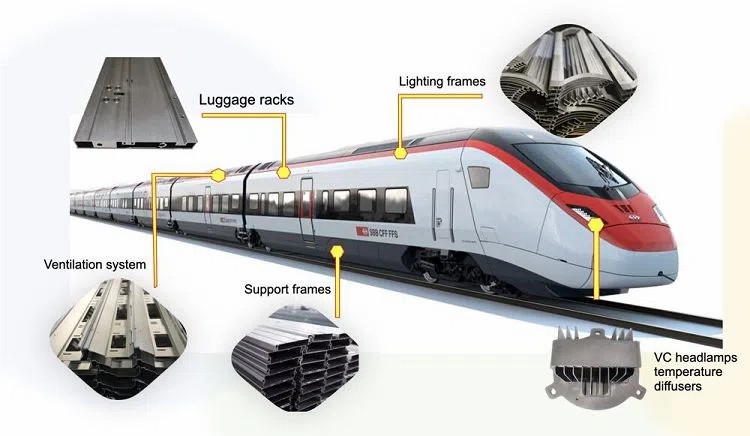
- Equipment Compartments (Belly Panels): Located under the car body, protecting critical equipment like bogies. Made from aluminum profiles and sheets, requiring resistance to vibration, stone impact, and easy disassembly for maintenance.
- Interior Decor and Equipment:
- Luggage Racks: Bent and welded from aluminum profiles, lightweight and strong.
- Seat Frames: Combinations of aluminum die-castings and profiles, an important part of weight reduction.
- Ceiling Panels, Wall Panels, Window Frames: Extensive use of aluminum profiles and sheets, aesthetic and durable.
- Air Ducts: Aluminum alloy ducts are lightweight, offer good sealing, and low thermal conductivity.
- Underframe and Bogie Components: Although the bogie frame is still primarily steel, various brackets and covers on it are increasingly made from high-strength aluminum alloy.
- Electrical Systems: Conductive rails, busbars, etc., extensively use high-conductivity aluminum alloy.
V. Core Capabilities of an Industrial Aluminum Profiles Manufacturer
To produce aluminum profiles that meet the stringent requirements above, a manufacturer must possess comprehensive core capabilities:
- Alloy R&D and Formulation Capability: Ability to recommend or custom-develop the most suitable aluminum alloy grades based on different customer performance requirements (strength, weldability, corrosion resistance).
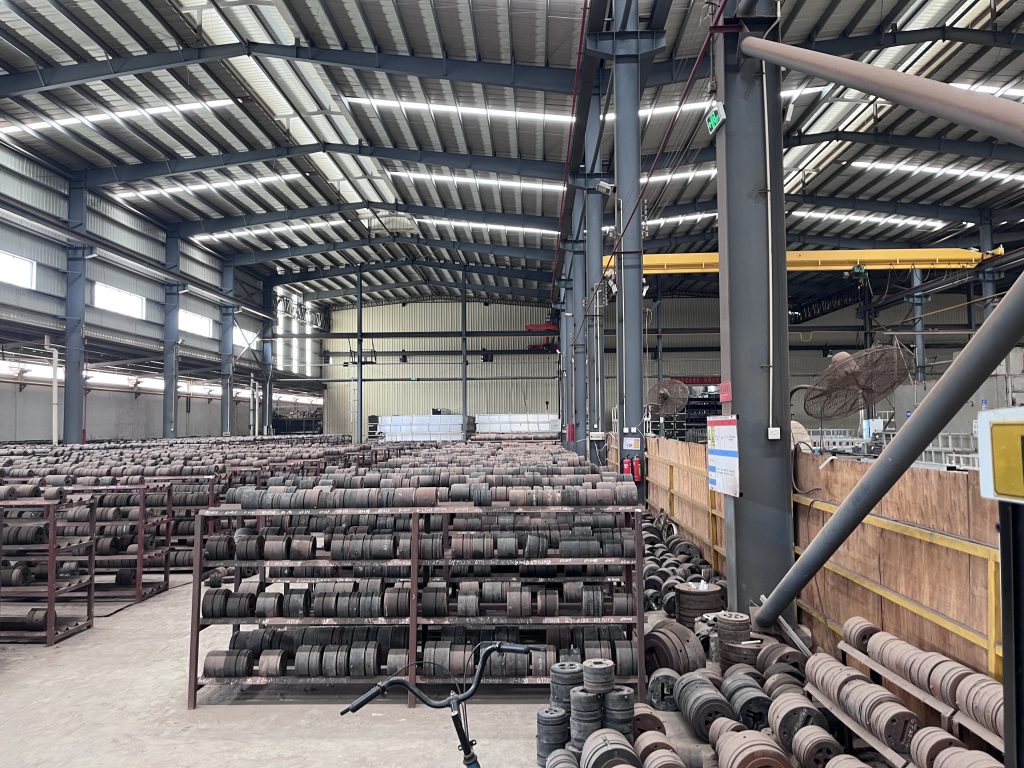
- Large Extrusion Mold Design and Manufacturing Capability: Molds are the soul of extruded profiles. Designing and manufacturing precision molds capable of producing ultra-wide, thin-walled, complex multi-cavity profiles is a key technical barrier.
- Super-Large Tonnage Extrusion Capacity: Requires ultra-large extrusion presses of over 7500 tons to stably produce the large profiles needed for railway vehicles.
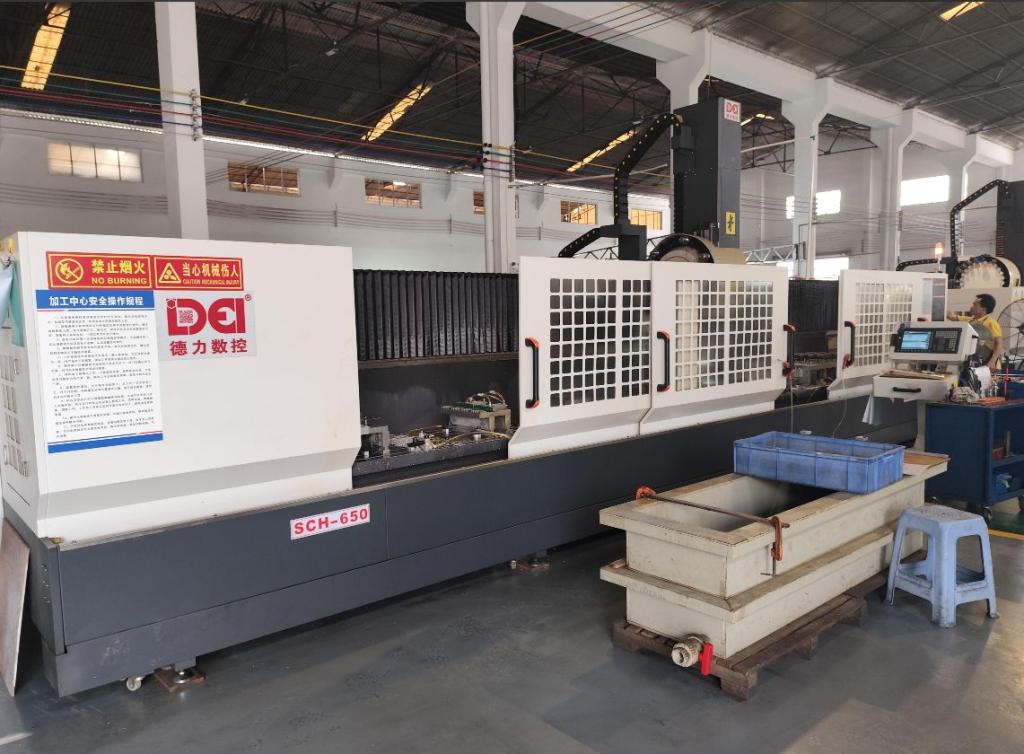
- Precision Machining and Welding Technology: Equipped with advanced facilities like CNC machining centers, laser cutting, FSW, and automated MIG welding to ensure dimensional accuracy and connection strength.
- Comprehensive Testing System: Must establish a zero-defect quality control system from chemical composition analysis and mechanical property testing to ultrasonic flaw detection and 3D coordinate measurement, ensuring every profile is safe and reliable.
Future Trends and Outlook
Future trends for aluminum profiles in rail transportation will develop in the following directions:
- Further Integration: Using larger, more complex profiles to further reduce part count and welding.
- New Materials and Processes: Application of new materials like aluminum matrix composites and foam aluminum, and using 3D printing (additive manufacturing) for complex, low-volume parts.
- Intelligence and Digitalization: Integrating digital twin technology to simulate the extrusion process and performance during the design phase, optimizing designs and reducing trial-and-error costs.
- Green Circular Economy: Establishing a complete closed-loop recycling system from end-of-life car bodies back to recycled aluminum, reducing the entire lifecycle carbon footprint.
Conclusion
From speeding high-speed trains to shuttling city subways, aluminum profiles silently support the rapid development of modern rail transportation with their lightweight yet robust nature. The train front-end, floor, roof, sidewalls, and every detail shine with the technological light of aluminum alloy.
As a manufacturer deeply rooted in the industry, we understand our responsibility – to provide not just products, but also safety, efficiency, and a sustainable future. We look forward to partnering with more global railway vehicle manufacturers, using our cutting-edge aluminum profile solutions to jointly drive the rail transportation industry towards a more brilliant tomorrow.
Learn More :https://www.sjhmalu.com/
Keywords: Industrial Aluminum Profiles Manufacturer, Railway Vehicle Aluminum Profiles, Train Front-End Aluminum Profiles, Roof System Aluminum Profiles, Vehicle Sidewall Aluminum Profiles, Aluminum Honeycomb Floor, Large Aluminum Alloy Extruded Profiles, Rail Transit Lightweighting, High-Speed Train Materials, Aluminum Alloy Extrusion Process