
Aluminum alloy profile applications from aluminum profiles manufacturers & one-stop aluminum profile solutions
- By:SJHM
- Date:25-12-2025
In today’s rapidly developing industrial era, aluminum alloy profiles have become a crucial material supporting modern industrial advancement and improved quality of life, thanks to their exceptional properties such as being lightweight yet high-strength, corrosion-resistant, easy to process, environmentally friendly, and recyclable. With the rapid development of China’s national economy and high-tech industries, the aluminum processing sector is continuously breaking new ground in high performance, high precision, energy saving, and environmental protection. According to statistics, China’s aluminum processing products encompass approximately 300 alloys and 1,500 varieties, making it one of the countries with the richest product diversity in the world. As a professional industrial aluminum profile manufacturer, we not only provide a diverse range of aluminum profile products but have also established a complete industrial chain service system—from “alloy development, mold design, extrusion forming, surface treatment, precision deep processing, to component assembly”—offering a one-stop solution for our customers.
aluminum profiles manufacturers
Profile Basic Properties and Material Science
1.1 Excellent Characteristics of Aluminum Alloy Materials
The wide application of aluminum alloys across numerous fields stems from their unique material properties:
- Lightweight and High Strength: The density of aluminum alloy is only one-third that of steel, while its specific strength (strength-to-density ratio) approaches or even exceeds that of high-quality steel, making it an ideal material for lightweighting.
- Excellent Formability: Aluminum alloy can be processed into complex cross-sectional profiles through various methods like extrusion, rolling, and casting, meeting the structural needs of different application scenarios.
- Strong Corrosion Resistance: A dense oxide film naturally forms on the surface of aluminum alloy, providing excellent atmospheric corrosion resistance. This resistance can be further enhanced through surface treatment.
- High Electrical and Thermal Conductivity: The electrical conductivity of aluminum alloy is about 61% of pure aluminum and over 50% of copper. Its excellent thermal conductivity makes it an ideal material for heat dissipation applications.
- Environmentally Friendly and Recyclable: Aluminum has a recycling rate of over 95%, with the energy consumption for recycled aluminum being only 5% of that for primary aluminum, meeting sustainable development requirements.
- Aesthetic and Easy to Treat: The surface of aluminum alloy can be treated with various processes such as anodizing, electrophoretic coating, powder coating, and wood grain transfer to achieve rich decorative effects.
aluminum profiles manufacturers
1.2 Scientific Selection of Alloy Systems
Depending on the material performance requirements of different application fields, we can provide the following mainstream aluminum alloy series:
- 1xxx Series Pure Aluminum (e.g., 1050, 1060, 1100): Purity over 99%, excellent electrical/thermal conductivity and formability, strong corrosion resistance, but relatively lower strength. Mainly used for conductive materials, heat exchangers, chemical containers, etc.
- 2xxx Series Duralumin (e.g., 2014, 2024, 2A12): Copper is the main alloying element, offering high strength and hardness, but relatively poorer corrosion resistance. Primarily used in aerospace, military industries, and other fields requiring high strength.
- 3xxx Series Anti-Corrosion Aluminum (e.g., 3003, 3004, 3A21): Manganese is the main alloying element, with medium strength, good formability, and corrosion resistance. Widely used in chemical equipment, architectural decoration, cookware, etc.
- 5xxx Series Anti-Corrosion Aluminum (e.g., 5052, 5083, 5A05): Magnesium is the main alloying element, offering medium strength, excellent corrosion resistance, and good weldability. Suitable for welded structures in ships, vehicles, pressure vessels, etc.
- 6xxx Series Duralumin (e.g., 6061, 6063, 6082): Magnesium and silicon are the main alloying elements, offering excellent overall properties, ability to be strengthened by heat treatment, and good corrosion resistance and weldability. This is the most widely used extruded aluminum alloy series, covering construction, transportation, electronics, and more.
- 7xxx Series Super Duralumin (e.g., 7075, 7050, 7A04): Zinc is the main alloying element, capable of achieving very high strength through heat treatment, but with relatively poorer corrosion resistance. Mainly used for high-strength structural components in aerospace, sports equipment, etc.
aluminum profiles manufacturers
Full Process of One-Stop Aluminum Profile Solutions
2.1 Mold Design and Manufacturing
The mold is the core of aluminum profile extrusion forming, and its quality directly affects the dimensional accuracy and surface quality of the profile:
- Runner Optimization Design: Finite element simulation is used to analyze metal flow, optimizing the mold runner structure to ensure uniform metal flow, reducing profile warping, twisting, and surface defects.
- Strength and Lifespan Design: Based on extrusion process parameters and profile cross-sectional characteristics, the mold structure is rationally designed to ensure sufficient strength and a long service life.
- Surface Treatment Technology: Surface strengthening treatments like nitriding and titanium plating are applied to the mold’s working belt to improve its wear resistance and anti-sticking properties, extending its service life.
- Rapid Response Capability: A rapid-response mechanism for mold design and manufacturing is established, with a lead time as short as 7-15 days from customer drawings to completed mold, meeting urgent customer needs.
2.2 Extrusion Forming Process
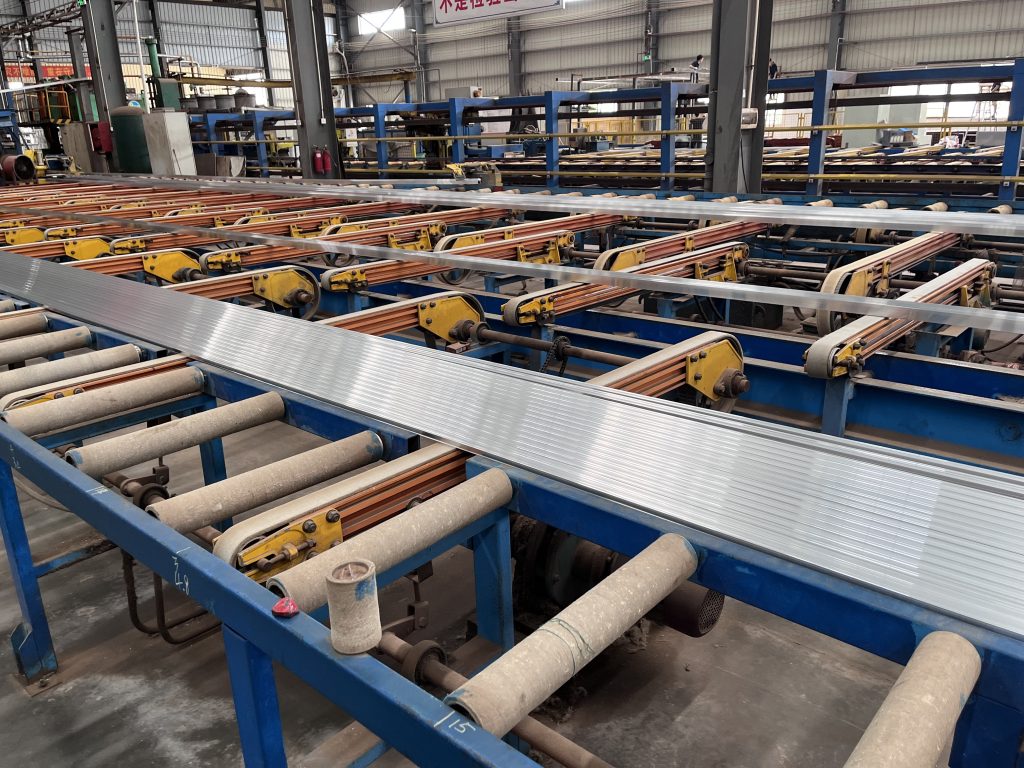
Extrusion is the key process for shaping aluminum profiles. We employ advanced equipment and process control technology:
- Large-tonnage Extrusion Presses: Equipped with a series of extrusion presses ranging from 800 to 3600 tons, capable of producing profiles with circumscribed circle diameters from 30mm to 350mm, meeting requirements for different cross-sectional sizes.
2.3 Surface Treatment Technology
Diverse surface treatment solutions are provided based on application environment and aesthetic requirements:
- Anodizing: Including standard sulfuric acid anodizing, hard anodizing, micro-arc oxidation, etc. This forms a hard, wear-resistant, corrosion-resistant oxide film and provides various colors like silver, bronze, titanium gold, and black.
- Electrophoretic Coating: Electrophoretic coating applied on top of anodizing yields a uniform, dense, and strongly adherent paint film.
- Powder Coating: Utilizing environmentally friendly powder coatings applied via electrostatic spraying and high-temperature curing, forming a coating with uniform thickness and rich colors, offering excellent decorative effects.
- Fluorocarbon Coating: Using PVDF fluorocarbon coatings with excellent weatherability, self-cleaning properties, and chemical corrosion resistance, suitable for high-end architecture and harsh environments.
- Wood Grain Transfer: Using thermal transfer technology to create realistic wood grain effects on aluminum profile surfaces, combining metal strength with wood texture, widely used in all-aluminum home furnishings.
2.4 Precision Deep Processing
To meet customer assembly and usage needs, comprehensive deep processing services are provided:
- CNC Machining: Equipped with multiple CNC machining centers capable of precision machining such as milling, drilling, tapping, and engraving.
aluminum profiles manufacturers
Innovative Applications of High-End Aluminum Profiles in Various Fields
3.1 Architectural Aluminum Profiles: The Perfect Combination of Safety, Aesthetics, Energy Efficiency, and Environmental Protection
Architectural aluminum profiles are an important component of modern buildings, with continuously innovating and expanding applications:
- Curtain Wall Systems: Various systems like unitized curtain walls, stick curtain walls, and point-supported curtain walls meet different architectural styles and performance requirements. Using 6063-T5, 6063-T6 aluminum alloys with thermal break designs achieves significant energy savings.
- Sunrooms and Skylights: Utilizing high-strength aluminum alloy structures.
- Railings and Handrails: Using aluminum alloy materials to replace traditional stainless steel and ironwork offers advantages like light weight, corrosion resistance, low maintenance, and diverse designs, with surfaces that can be treated in various colors and textures.
Our one-stop service for architectural aluminum profiles includes: profile cross-sectional design based on architectural style and performance requirements → alloy optimization (mainly 6063, 6061, 6005) → mold development → extrusion forming → surface treatment (powder coating, fluorocarbon coating, anodizing, wood grain transfer, etc.) → deep processing (cutting, drilling, slot milling, etc.) → hardware accessory provision, ensuring the overall performance of the architectural aluminum profile system.
3.2 Industrial Aluminum Profiles: The Foundational Support for Smart Manufacturing
Industrial aluminum profiles serve as the skeletal material for automated equipment, production lines, and storage systems, featuring standardization, modularity, easy assembly, and scalability:
- Automation Equipment Frames: Using European or Chinese standard aluminum profiles with specialized connectors allows for rapid setup of equipment racks, protective covers, workbenches, etc., shortening equipment manufacturing cycles.
- Conveyor Line Systems: Aluminum profiles serve as supports and tracks for conveyor lines, being lightweight, corrosion-resistant, and easy to clean, meeting hygiene requirements in food, pharmaceutical, and other industries.
- Industrial Fencing and Safety Guards: Modular aluminum profile guard systems are easy to install, aesthetically pleasing, and durable, and can be combined with materials like acrylic sheets or metal mesh for equipment safety.
- Cleanroom Structures: Aluminum alloy materials do not generate dust, are easy to clean, and resist disinfectant corrosion, making them ideal for cleanroom structures in electronics, pharmaceuticals, food, and other industries.
- Display and Storage Systems: Aluminum profile display racks and shelving are lightweight, have good load-bearing capacity, and are aesthetically pleasing, allowing flexible adjustment based on display and storage needs.
Our one-stop service for industrial aluminum profiles includes: selection based on load and precision requirements (commonly 6063-T5, 6061-T6) → providing standard profiles or developing custom cross-sections → precision extrusion ensuring dimensional tolerances → surface treatment → precision cutting → machining connection holes/slots → providing matching connectors and assembly guidance.
3.3 All-Aluminum Home Furnishing Profiles: A New Eco-Friendly and Healthy Lifestyle Choice
All-aluminum home furnishings offer advantages like zero formaldehyde, waterproofing/damp-proofing, corrosion resistance, high strength, and recyclability, serving as an upgraded alternative to traditional panel furniture:
- Cabinet Systems: Aluminum alloy cabinets are water-resistant, warp-free, and easy to clean, with surfaces that can be treated to resemble wood grain, stone patterns, etc., being both beautiful and practical.
- Wardrobe and Storage Systems: Aluminum alloy wardrobes are damp-proof, moth-proof, have good load-bearing capacity, and allow flexible internal adjustment, suitable for humid regions and high-end residences.
- Doors, Windows, and Partitions: Aluminum alloy interior doors and partition systems, combined with glass, panels, etc., enable flexible space division and decorative effects.
- Bathroom Vanities: Completely resistant to moisture erosion, with a long service life, suitable for humid bathroom environments.
- Outdoor Furniture: Aluminum alloy outdoor tables, chairs, gazebos, etc., offer strong weatherability, are low-maintenance, and retain their appearance over time.
3.4 Heat Sink Aluminum Profiles: Technical Guarantee for Efficient Heat Dissipation
As the power density of electronic devices continues to increase, heat dissipation becomes a key factor limiting device performance. Aluminum profile heat sinks are widely used due to their high thermal conductivity and ease of processing:
- LED Lighting Heat Dissipation: For high-power LED lighting, various efficient heat sinks like sunflower-type and fin-type are developed. Optimizing fin design and surface treatment improves heat dissipation efficiency.
- Power Electronics Heat Dissipation: Profile heat sinks are developed for power electronic devices like IGBTs, SCRs, and GTOs, combined with air or liquid cooling to ensure devices operate within safe temperature ranges.
- Computer and Communication Equipment Heat Dissipation: CPU coolers, graphics card coolers, chassis coolers, etc. As devices miniaturize, composite cooling technologies combining high-density fins, heat pipes, and vapor chambers are developing.
- New Energy Heat Dissipation: Heat dissipation systems for photovoltaic inverters, electric vehicle motor controllers, battery packs, etc., require high reliability, lightweight design, and long life.
Our one-stop service for heat sink aluminum profiles includes: optimizing heat sink cross-section (increasing surface area and efficiency) → selecting high thermal conductivity alloys (6063, 6061, thermal conductivity ≥200W/(m·K)) → precision extrusion ensuring uniform fin thickness → surface treatment (typically black anodizing to improve radiative heat dissipation) → machining flatness (ensuring good contact with the heat source).
3.5 Rail Transit Aluminum Profiles: The Art of Balancing Lightweighting and Safety
Lightweighting in rail transit is key to energy saving, consumption reduction, and increasing transport capacity. Aluminum alloy is the material of choice for lightweighting rail vehicles:
- Car Body Structure: Includes large hollow aluminum profiles for underframes, sidewalls, roofs, and end walls. Welding of long, large aluminum alloy profiles reduces part count and weld length, improving body strength and stiffness.
- Doors and Windows: Aluminum alloy door and window frames are lightweight, high-strength, and have good sealing, meeting airtightness requirements for high-speed operation.
- Interior Systems: Seat frames, luggage racks, wall panels, ceiling panels, etc., use aluminum alloy materials, offering lightweight and good fire resistance.
- Bogie Components: Some bogie components are experimenting with high-strength aluminum alloys to further reduce unsprung mass and improve ride stability.
3.6 Aerospace Aluminum Profiles: Material Challenges in Extreme Environments
The aerospace field has extremely stringent material requirements. Aluminum alloys continue to make breakthroughs in specific strength, heat resistance, and corrosion resistance:
- Airframe Structure: Primary load-bearing structural components like skin, stringers, frames, and ribs use high-strength, high-toughness aluminum alloys such as 2024, 2124, 7075, 7050, formed by extrusion, rolling, forging, etc.
- Wings and Empennage: Structural components like spars, ribs, and panels require high strength and high fatigue performance, using newer generation high-strength, high-toughness alloys like 7150, 7055, 7085.
- Engine Components: Engine nacelles, brackets, guide vanes, etc., require high-temperature resistance, using heat-resistant aluminum alloys like 2219, 2618.
- Interior and Windows: Cabin interiors, luggage racks, window frames, etc., focus on lightweighting and fire performance while meeting strength requirements.
3.7 Automotive Aluminum Profiles: Dual Drivers of Lightweighting and New Energy
Automotive lightweighting is a key pathway for energy saving and emission reduction. The application of aluminum alloys in traditional internal combustion engine vehicles and new energy vehicles continues to expand:
- Body Structure: Bumpers, crash rails, door frames, roof rails, etc., use high-strength aluminum alloys to achieve lightweighting while ensuring safety.
- Chassis Systems: Subframes, control arms, steering knuckles, etc., use forged or extruded aluminum alloys to reduce unsprung mass and improve handling.
- Battery Pack Systems: Battery pack enclosures, brackets, cooling plates for new energy vehicles require high rigidity, high sealing, and good heat dissipation, often made from welded extruded aluminum profiles.
- Thermal Management Systems: Engine radiators, intercoolers, A/C condensers, battery cooling plates, etc., use aluminum profile components like multi-port tubes and fins to improve heat exchange efficiency.
- Interior and Trim Parts: Instrument panel supports, seat frames, trim strips, etc., are lightweight and recyclable.
Innovative Applications of Aluminum Profiles in Emerging Fields
4.1 Medical Equipment Aluminum Profiles: Guarantee of Safety and Hygiene
The medical field has extremely high requirements for material biocompatibility, corrosion resistance, and cleanability. Aluminum alloy is an ideal material for medical equipment:
- Medical Beds and Stretchers: Aluminum alloy medical beds are lightweight, strong, easy to move, with surfaces easy to clean and disinfect, meeting hospital hygiene requirements.
- Medical Equipment Stands: Stands and mobile components for large medical equipment like CT, MRI, and X-ray machines require high rigidity and dimensional stability.
- Surgical Instruments and Devices: Some surgical instruments use aluminum alloy, being lightweight for easier handling by medical staff.
- Medical Gas Systems: Piping and terminals for medical gases like oxygen and vacuum use aluminum alloy, being corrosion-resistant, clean, and non-polluting.
- Rehabilitation Aids: Wheelchairs, walkers, crutches, etc., made from aluminum alloy are lightweight and sturdy, improving patient comfort.
4.2 New Energy Field Aluminum Profiles: Supporting Green Energy
The development of the new energy industry has opened new application spaces for aluminum profiles:
- PV Mounting Systems: Ground-mounted and distributed PV mounting systems use aluminum alloy, offering corrosion resistance, low maintenance, and long life, especially suitable for harsh environments like coastal and high-humidity areas.
- Solar Panel Frames: Aluminum alloy frames for PV modules protect the glass, increase module strength, and facilitate installation.
- Wind Power Components: Wind turbine tower platforms, nacelle components, blade connection parts, etc., use aluminum alloy to reduce weight, facilitating lifting and maintenance.
- Aluminum-Air Batteries: The anode of aluminum-air batteries uses high-purity aluminum, offering high energy density, usable as emergency power or EV range extenders.
- Hydrogen Storage and Transport Equipment: Aluminum alloy liners for hydrogen storage tanks are lightweight and resistant to hydrogen embrittlement, key components for hydrogen fuel cell vehicles.
4.3 Marine and Offshore Engineering Aluminum Profiles: The Challenge of Corrosion Resistance
The marine and offshore engineering environment is harsh, demanding extremely high material corrosion resistance:
- Hull Structures: Hulls, decks, and superstructures for small yachts, high-speed passenger ships, and naval vessels use seawater corrosion-resistant 5xxx and 6xxx series aluminum alloys to reduce weight, increase speed, and payload.
- Ship Fittings: Masts, railings, doors/windows, ladders, etc., made from aluminum alloy are corrosion-resistant and low-maintenance.
- Offshore Platforms: Topside modules, helidecks, living quarters on offshore oil platforms use aluminum alloy to reduce weight, lower the center of gravity, and improve stability.
- Desalination Equipment: Evaporators, piping, etc., in desalination plants use seawater corrosion-resistant aluminum alloys to extend equipment life.
As a fundamental material in modern industry, the application fields of aluminum profiles continue to expand, with technological innovations constantly breaking through. From building curtain walls to rail transit, from electronics heat dissipation to aerospace, and from all-aluminum homes to new energy vehicles, aluminum profiles support the development of various industries with their excellent performance and diverse functions. As a professional industrial aluminum profile manufacturer, we consistently adhere to the one-stop service philosophy of “alloy development – mold design – extrusion forming – surface treatment – precision deep processing – component assembly.” Guided by customer needs, driven by technological innovation, and founded on reliable quality, we provide comprehensive aluminum profile solutions for our customers. Please feel free to contact us to learn more about aluminum profile application solutions or to obtain professional customization services.
Learn more:https://www.sjhmalu.com/product