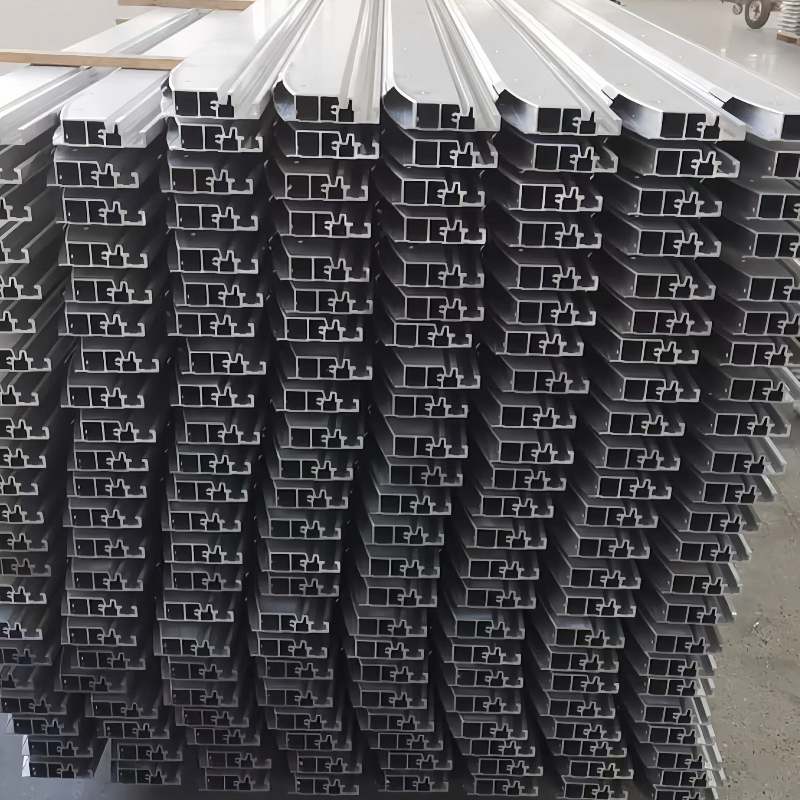
Aluminium Profiles in Construction
- By:SJHM
- Date:18-12-2025
Pioneering a Green Future Introduction: Aluminium Profiles in Construction, Defining New Standards for Modern Architectural Aesthetics and Performance
Aluminium Profiles in Construction represent one of the most critical application areas for the aluminium industry, with approximately 20% of global aluminium production serving the construction sector. In developed countries, this figure rises to over 30%. The application of Aluminium Profiles in Construction has far surpassed traditional perceptions, functioning as a “multi-system solution” that permeates every part of a building’s anatomy.
1. The “Main Force” of the Building Envelope
- Curtain Wall Systems: Whether unitized, stick, all-glass, or point-supported, Aluminium Profiles in Construction serve as the mullions and framing—the “skeleton” of a building’s skin. They provide the high-precision, high-strength foundation required for complex curves and precise sealing, giving structures a dynamic, transparent, or solid and appearance.
- Window & Door Systems: From high-performance thermally broken windows and doors to ultra-slim panoramic doors, Aluminium Profiles in Construction offer exceptional airtightness, watertightness, wind load resistance, and thermal insulation. They are the first line of defense for building energy efficiency and the visual frame connecting interior and exterior landscapes.
- Skylights & Canopies: Introducing natural light and creating comfortable transitional spaces, the structural strength and weather resistance of Aluminium Profiles in Construction ensure the safety and longevity of these large-area glazed structures.
2. The “Enabler” for Interior Spaces and Structures
- Partitions & Decor: From glass partitions in offices to decorative trim in malls and stair railings, Aluminium Profiles in Construction provide flexible space division and enhanced interior quality solutions, thanks to their light weight, aesthetic appeal, and quick installation.
- Structural Components: In buildings with long spans, lightweight designs, or special shapes, high-strength Aluminium Profiles in Construction can be used directly as beams, columns, or space frames, achieving “aluminium-for-steel” substitution and reducing structural weight.
- Formwork (Aluminium Formwork): As a new green construction technology, aluminium formwork boasts high strength, precision, high reusability (over 300 cycles), excellent finish, and high scrap value, gradually replacing traditional wood and steel forms.
3. The “Pioneer” in Emerging Applications
- Building-Integrated Photovoltaics (BIPV): Aluminium Profiles in Construction are the primary material for PV module frames and support structures. Their corrosion resistance, light weight, and high strength perfectly meet the needs of integrating PV systems with buildings, helping structures transition from energy consumers to producers.
- Modular Construction: In prefabricated buildings, the easy machinability, reliable connection, and high precision of Aluminium Profiles in Construction make them the ideal choice for modular unit frames, significantly increasing factory production levels and on-site installation efficiency.
Eight Core Advantages
The widespread use of Aluminium Profiles in Construction is rooted in a series of unparalleled superior properties.
- Exceptional Material Stability
Aluminium alloys naturally form a dense oxide film, providing an excellent foundation for corrosion resistance. Advanced surface treatments like anodizing, electrophoresis, powder coating, and fluorocarbon (PVDF) spraying enhance and color this protective layer. This allows them to withstand harsh environments like acid rain, salt spray, and UV radiation without warping, softening, or embrittlement, ensuring long-lasting performance. Their stable thermal expansion coefficient and high dimensional accuracy guarantee long-term tightness of building joints. - Durability Synchronized with the Building
Through a systematic engineering approach of “high-quality alloy + precision extrusion + high-end surface treatment,” modern Aluminium Profiles in Construction can have a design service life of over 50 years, truly achieving synchronization with the main structure’s lifespan. - Outstanding Wind Load Resistance and Structural Performance
Through scientific cross-sectional design and alloy formulation (e.g., 6061, 6063-T5/T6 tempers), Aluminium Profiles in Construction possess a high strength-to-weight ratio. Their wind load resistance is particularly outstanding, meeting the extreme mechanical demands for building envelopes in skyscrapers and coastal typhoon zones, acting as a safe and reliable “building armor.” - Unmatched Machinability and Design Freedom
Aluminium’s good ductility allows it to be extruded into profiles of almost any complex cross-section. This unlocks boundless creative potential for architects—whether sharp angles, fluid curves, or functionally integrated multi-chamber structures can be accurately realized. Subsequent processes like cutting, drilling, and milling are also extremely convenient. - Minimal Maintenance and Upkeep
High-quality Aluminium Profiles in Construction have smooth, dense surfaces that resist dust and staining. Routine cleaning often requires just rainwater rinsing or simple washing. Their durability avoids frequent repairs and replacements, resulting in significantly lower whole-lifecycle maintenance costs compared to traditional materials like wood and steel. - Rich Decorative Appeal and Aesthetic Expression
From metallic finishes like silver, bronze, and champagne to any custom color in the RAL or Pantone spectrum; from glossy and matte to realistic wood grain and stone textures—Aluminium Profiles in Construction, through processes like anodic coloring, powder coating, PVDF spraying, and thermal transfer printing, offer virtually unlimited aesthetic choices. They can perfectly interpret modernist minimalism, classical sophistication, or futuristic tech aesthetics. - Significant Whole-Lifecycle Economy
- Lightweighting: With a density only one-third that of steel, it significantly reduces building loads, potentially lowering foundation and structural costs.
- Fast Construction: High-profile precision enables easy assembly, significantly shortening project timelines and saving labor and management costs.
- Energy Efficiency Benefits: When combined with insulating glass units (IGUs) with Low-E coatings, energy-saving window and curtain wall systems using Aluminium Profiles in Construction can reduce building heating and cooling energy consumption by 40%-50%, leading to very low long-term operational costs.
- High Residual Value: Aluminium itself has high recycling value.
- End-to-End Green Environmental Performance
This is the most core sustainable advantage of Aluminium Profiles in Construction. Aluminium is 100% infinitely recyclable. The energy required for recycling and remelting is only about 5% of that for primary aluminium production, and material loss per recycling cycle is only 3.5%-8.5%.
How Aluminium Profiles Enable High-Performance Buildings
- The Core of Thermal Insulation Technology: Thermal Break Systems
The “thermal break” is a revolutionary technology for enhancing the thermal performance of aluminium windows and doors. It involves embedding a high-strength, low-thermal-conductivity polyamide (PA66) strip between the interior and exterior parts of the aluminium profile, effectively blocking the “bridge” for heat conduction. Combined with multi-chamber designs and thermal insulation filling materials, modern thermally broken Aluminium Profiles in Construction can achieve U-values as low as 1.0 W/(m²·K) or below, matching or even exceeding the insulation of some traditional materials. - Surface Treatment Processes: Guardians of Aesthetics and Longevity
- Anodizing: Creates a hard, corrosion-resistant oxide layer on the base metal through electrochemical principles, with options for electrolytic coloring. It offers high hardness, good wear resistance, and retains the metallic look.
- Electrophoretic Coating (E-Coat): Builds upon anodizing by depositing an acrylic resin film into the oxide layer’s pores. It provides uniform color, strong stain resistance, and a smooth finish.
- Powder Coating: Involves electrostatically applying dry powder paint to the profile surface, then curing it. It offers the widest color selection, is solvent-free (eco-friendly), and provides good weather resistance.
- Fluorocarbon Coating (PVDF): Uses polyvinylidene fluoride resin, applied in multiple layers and baked. It offers excellent weatherability, self-cleaning properties, and UV resistance, making it the preferred choice for high-end curtain walls and harsh environments, with color and gloss retention guaranteed for over 25 years.
- Structural System Innovation: Ensuring Safety and Precision
Modern Aluminium Profiles in Construction employ systematic, integrated design. Everything from the profile cross-section, hardware, sealing gaskets, to connection structures is precisely calculated and tested. Technologies like multi-point locking systems, pressure-equalized rain screen principles, and flexible bracket designs work together to ensure outstanding wind resistance, airtightness, watertightness, and seismic performance for curtain walls and windows, safeguarding both the building and its occupants.
Trends and Future Outlook for Aluminium Profiles in Construction
- Higher Performance and Functional Integration
Future profiles will evolve towards higher strength, better insulation, and greater functional integration. Examples include profiles integrating hidden drainage, ventilation, and shading louvres, as well as composite profiles combining structural load-bearing with decorative functions. - Smart and Responsive Buildings Aluminium Profiles in Construction will integrate with Internet of Things (IoT) technology, becoming the “sensory organs” and “actuators” of smart buildings. For instance, smart window frames with integrated light, temperature, and humidity sensors can automatically adjust shading and ventilation. Curtain wall units could function as information displays or photovoltaic panels, making building facades “intelligent” and “active.”
- Digital Design and Smart Manufacturing
The deep application of parametric design and Building Information Modeling (BIM) enables the full-process digitalization of design, detailing, production, and installation for complex, non-standard curtain walls. Combined with Industry 4.0 smart extrusion centers and flexible production lines, this allows for mass customization, quickly responding to the needs of personalized, small-batch high-end projects. - The Ultimate Pursuit of Sustainability
Beyond recyclability, future focuses will also include:- Use of Low-Carbon Aluminium: Utilizing primary aluminium produced using green energy like hydropower to further reduce the carbon footprint.
- Increasing Recycled Aluminium Content: Raising the proportion of recycled aluminium used in construction profiles while ensuring performance.
- Life Cycle Assessment (LCA): Quantifying the environmental impact of Aluminium Profiles in Construction across the entire journey from raw material and production to transport, use, and recycling, providing data for green building certifications.
From basic shelter to defining city skylines; from fulfilling practical functions to carrying aesthetic expression and sustainable ideals, the development history of Aluminium Profiles in Construction is a history of the evolution of modern building technology. With their combined advantages of strength, light weight, durability, beauty, and environmental friendliness, they have become the indispensable “green skeleton” and “intelligent skin” for contemporary and future architecture. As a manufacturer deeply rooted in the industry, we provide not just products, but committed system solutions. We possess advanced extrusion lines, surface treatment workshops, complete testing laboratories, and a professional R&D team, striving for excellence from material science and cross-sectional design to surface treatment and system application. We are ready to partner with architects, developers, and builders, using every high-quality aluminium profile to jointly build safer, more comfortable, energy-efficient, and beautiful living environments—creating buildings that stand firmly in the present and are worthy of the future. Let the outstanding performance of Aluminium Profiles in Construction achieve the enduring value of your building.
Learn more:https://www.sjhmalu.com/product
cncmachining ,cncprogramming ,machineshop ,manufacturing ,manufacturingindustry ,aluminum,precisionmachining,machinedparts,aluminum profiles manufacturer, 6061aluminum,6063