
What Are the Key Properties of 7075 Aluminum for Machining?
- By:SJHM
- Date:09-07-2026
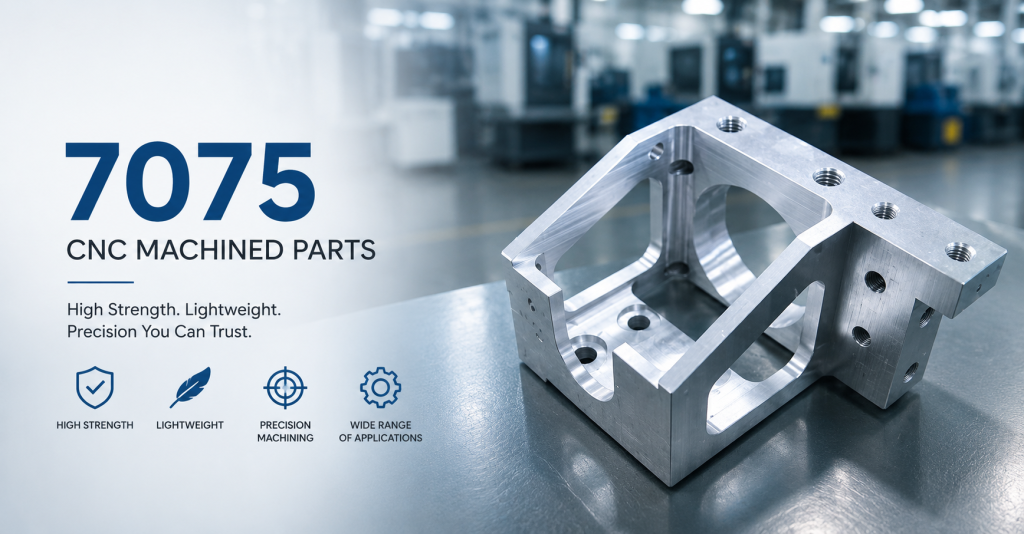
7075 machined parts
When strength, lightweight performance, and machining precision are equally important, 7075 aluminum is often the preferred material. Known as one of the strongest aluminum alloys available for commercial use, it has become the material of choice for demanding industries including aerospace, industrial automation, robotics, defense, semiconductor equipment, and high-performance vehicles.
Unlike standard aluminum extrusion profiles used in architectural or general industrial applications, 7075 machined parts are typically manufactured from extruded bars, plates, forged billets, or precision extrusions before undergoing CNC machining to achieve tight tolerances and complex geometries.
This guide explains the key machining properties of 7075 aluminum, its advantages over other alloys, common applications, manufacturing processes, and how one-stop machining services help manufacturers reduce costs while improving product quality.
What Is 7075 Aluminum?
7075 aluminum is a high-strength aluminum-zinc alloy primarily alloyed with zinc, magnesium, and copper. It was originally developed for the aerospace industry and remains one of the strongest commercially available aluminum alloys today.
Common tempers include:
- 7075-T6
- 7075-T651
- 7075-T73
Among these, 7075-T6 is the most widely used for CNC machining because it offers excellent strength combined with good machinability.
Compared with common extrusion alloys such as 6061 or 6063, 7075 delivers significantly higher mechanical performance while maintaining the lightweight characteristics aluminum is known for.
Key Properties of 7075 Aluminum for Machining
Exceptional Strength
The primary reason manufacturers choose 7075 aluminum is its outstanding mechanical strength.
Typical mechanical properties include:
- Tensile Strength: approximately 510–570 MPa
- Yield Strength: approximately 430–500 MPa
- Excellent fatigue resistance
- High stiffness
- Excellent load-bearing capability
Its strength approaches that of certain structural steels while weighing roughly one-third as much.
This unique strength-to-weight ratio makes 7075 machined parts ideal for lightweight structures that must withstand high mechanical loads.
Excellent Machinability
Although 7075 is much stronger than standard aluminum alloys, it machines remarkably well.
Advantages include:
- High cutting speeds
- Excellent chip formation
- Reduced tool wear compared with many stainless steels
- Stable dimensional accuracy
- Outstanding surface finish
Because of these characteristics, manufacturers can efficiently produce:
- Complex CNC components
- Thin-wall precision parts
- Multi-axis machined components
- High-accuracy mounting plates
- Precision brackets
For manufacturers producing large batches, shorter machining cycles translate directly into lower production costs.
Outstanding Strength-to-Weight Ratio
Weight reduction has become a major design objective across many industries.
Replacing steel components with 7075 machined parts can significantly reduce equipment weight while maintaining structural integrity.
This is especially valuable in:
- Aircraft
- Industrial robots
- Automated machinery
- UAV systems
- High-performance vehicles
Lower weight often improves energy efficiency, increases payload capacity, and enhances operational performance.
Excellent Fatigue Resistance
Many industrial components experience repeated cyclic loading rather than constant static loads.
7075 aluminum performs exceptionally well under fatigue conditions, making it suitable for components such as:
- Robot arms
- Aircraft brackets
- Motion systems
- Machine frames
- Precision fixtures
This durability helps extend service life and reduce maintenance requirements.
Good Dimensional Stability
High-precision equipment demands materials that maintain their shape during machining and operation.
7075 exhibits excellent dimensional stability, making it well suited for:
- CNC precision machining
- Semiconductor equipment
- Medical devices
- Optical systems
- Inspection fixtures
The material maintains tight tolerances even after extensive machining.
Corrosion Resistance
Although 7075 offers reasonable corrosion resistance, it is generally lower than that of 6061 or 6063 due to its higher copper content.
To improve durability, many components receive additional surface treatments such as:
- Hard anodizing
- Clear anodizing
- Black anodizing
- Chemical conversion coating
- Powder coating (for selected applications)
Selecting the appropriate finish depends on the intended operating environment.
Why Is 7075 Popular for CNC Machining?
Modern CNC machining allows manufacturers to fully utilize the performance advantages of 7075 aluminum.
Common machining operations include:
- CNC milling
- CNC turning
- Precision drilling
- Tapping
- Pocket machining
- Multi-axis machining
- Surface finishing
- Deburring
Because of its excellent machinability, 7075 supports complex geometries that would be difficult or costly to produce using steel.
Industries That Use 7075 Machined Parts
Aerospace
The aerospace industry remains the largest consumer of 7075 aluminum.
Typical applications include:
- Aircraft structural brackets
- Wing components
- Fuselage supports
- Landing gear accessories
- UAV structural parts
- Satellite equipment
Lightweight construction directly contributes to fuel efficiency and payload optimization.
Industrial Automation
Automation equipment increasingly relies on lightweight precision components.
Examples include:
- Machine frames
- Fixture plates
- Tool holders
- Motion system supports
- Assembly equipment
High rigidity improves positioning accuracy while reducing moving mass.
Robotics
Industrial robots require components that combine strength with minimal weight.
Typical 7075 machined parts include:
- Robot arms
- Servo mounting plates
- End effector brackets
- Joint housings
- Precision connectors
Lower weight allows faster acceleration and higher operating efficiency.
Semiconductor Equipment
Semiconductor manufacturing demands extreme precision.
7075 is frequently used for:
- Wafer handling systems
- Vacuum chamber components
- Precision platforms
- Robotic transfer arms
- Equipment mounting plates
Its excellent dimensional stability supports micron-level machining accuracy.
Medical Equipment
Medical device manufacturers use 7075 aluminum for:
- Surgical robot components
- Imaging equipment frames
- Precision fixtures
- Medical instrument supports
Lightweight materials improve equipment performance while maintaining structural reliability.
Automotive and Motorsport
High-performance vehicles often incorporate CNC-machined 7075 components including:
- Suspension brackets
- Steering components
- Brake adapters
- Transmission supports
- Performance accessories
These parts reduce vehicle weight without sacrificing strength.
Unmanned Aerial Vehicles (UAVs)
Drone manufacturers continue to increase their use of 7075 due to its high stiffness and lightweight properties.
Applications include:
- Drone frames
- Camera mounts
- Gimbal supports
- Flight control housings
Weight savings directly improve flight endurance and payload capacity.
Manufacturing Process for 7075 Machined Parts
High-quality parts require more than premium raw material.
A complete manufacturing workflow generally includes:
Material Selection
Certified 7075 aluminum bars, plates, or extrusions are selected based on mechanical requirements.
Precision CNC Machining
Advanced CNC equipment produces:
- Tight tolerances
- Complex geometries
- High repeatability
Surface Treatment
Depending on the application, components may receive:
- Anodizing
- Hard anodizing
- Sandblasting
- Chemical conversion coating
Quality Inspection
Inspection typically includes:
- Coordinate Measuring Machine (CMM)
- Dimensional inspection
- Surface finish verification
- Material certification
- Mechanical property verification
Packaging
Protective packaging minimizes transportation damage and preserves surface quality.
Why Choose One-Stop Manufacturing for 7075 Machined Parts?
Many buyers source raw materials, machining, finishing, and inspection from different suppliers.
While this approach may appear flexible, it often increases:
- Lead times
- Logistics costs
- Communication complexity
- Quality risks
- Project management workload
A one-stop manufacturing partner integrates every production stage under one quality management system.
Benefits include:
- Faster project delivery
- Better dimensional consistency
- Reduced supplier coordination
- Lower overall manufacturing costs
- Simplified quality control
For OEM manufacturers and industrial equipment builders, integrated production often results in greater efficiency throughout the supply chain.
7075 vs. 6061 Aluminum for Machined Parts
| Property | 7075 | 6061 |
|---|---|---|
| Strength | Excellent | Good |
| Machinability | Excellent | Excellent |
| Weldability | Poor | Very Good |
| Corrosion Resistance | Good | Excellent |
| Cost | Higher | Lower |
| Aerospace Applications | Excellent | Moderate |
| Precision Components | Excellent | Good |
For highly loaded structural parts, 7075 is generally the better choice.
For general industrial products requiring welding and corrosion resistance, 6061 remains an excellent option.
How to Select the Right Supplier for 7075 Machined Parts
When evaluating suppliers, consider more than machining capability.
A qualified manufacturing partner should provide:
- Certified raw materials
- Advanced CNC machining equipment
- Experienced engineering support
- Surface finishing services
- Strict quality inspection
- Material traceability
- On-time delivery
- One-stop manufacturing capabilities
Choosing a supplier with integrated extrusion, machining, finishing, and quality control helps minimize production risks while improving consistency.
7075 aluminum combines exceptional strength, excellent machinability, lightweight performance, and outstanding fatigue resistance, making it one of the best materials for demanding engineering applications.
From aerospace and robotics to semiconductor equipment and medical devices, 7075 machined parts continue to play a critical role in modern manufacturing.
Working with a supplier that offers one-stop services—from material sourcing and CNC machining to surface treatment and final inspection—can simplify procurement, improve quality consistency, and reduce overall project costs.
Whether you are developing precision automation equipment or lightweight structural components, selecting the right manufacturing partner is just as important as selecting the right aluminum alloy.
Learn more:https://www.sjhmalu.com/