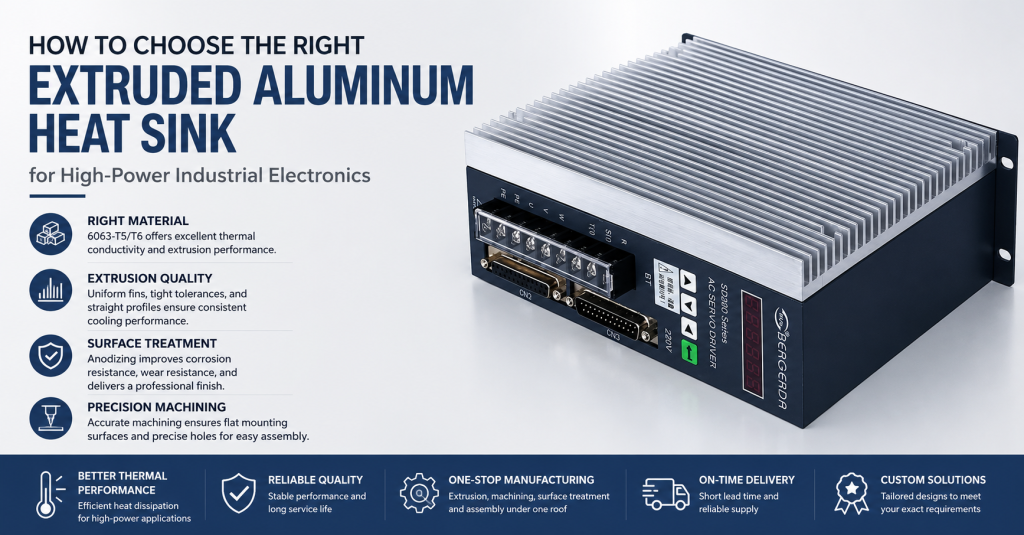
Industrial Extruded Aluminum Heat Sink: Materials, Surface Treatments, Applications & OEM Manufacturing Guide
- By:SJHM
- Date:30-07-2026
As industrial electronics continue to increase in power density, thermal management has become one of the most important considerations in product design. Whether it is a servo drive, industrial power supply, EV charging system, battery energy storage system (BESS), automation controller, or AI computing equipment, excessive heat can reduce efficiency, shorten component lifespan, and increase maintenance costs.
An Industrial Extruded Aluminum Heat Sink provides an effective passive cooling solution by maximizing surface area and efficiently transferring heat away from electronic components. Compared with fabricated or cast heat sinks, aluminum extrusion offers greater design flexibility, lower production costs for medium-to-high volumes, and excellent dimensional consistency.
This guide explains how to choose the right aluminum alloy, surface treatment, manufacturing process, and design considerations for industrial extruded aluminum heat sinks.
What Is an Industrial Extruded Aluminum Heat Sink?
An industrial extruded aluminum heat sink is a cooling component manufactured by forcing heated aluminum billets through a precision die to create a continuous profile with integrated cooling fins.
The extrusion process allows complex fin structures to be produced in a single operation, reducing machining requirements while improving manufacturing efficiency.
Typical features include:
- High-density cooling fins
- Lightweight construction
- Excellent thermal conductivity
- Large heat dissipation area
- Custom profile designs
- CNC machining compatibility
- Various surface treatment options
These characteristics make extruded heat sinks one of the most widely used cooling solutions in industrial electronics.
Why Aluminum Is the Preferred Material
Among all metals used for thermal management, aluminum offers one of the best balances between performance and manufacturing cost.
Advantages of Aluminum
- High thermal conductivity
- Low density
- Excellent corrosion resistance
- Easy extrusion into complex shapes
- Good machinability
- Attractive surface finish
- Cost-effective for mass production
- Fully recyclable
Compared with copper, aluminum is lighter and easier to process. Although copper transfers heat more efficiently, its higher weight and material cost often make aluminum the preferred choice for industrial applications.
Choosing the Right Aluminum Alloy
Selecting the proper alloy affects extrusion quality, cooling efficiency, machining performance, and appearance.
6063 Aluminum
6063-T5 and 6063-T6 are the most commonly used alloys for extruded heat sinks.
Advantages
- Excellent extrusion performance
- Thin fin capability
- Smooth surface finish
- Excellent anodizing quality
- Good thermal conductivity
- Cost-effective production
Typical applications include:
- Servo drives
- Industrial power supplies
- LED lighting
- Communication equipment
- Motor controllers
- EV chargers
For most industrial electronic cooling projects, 6063 provides the best combination of manufacturability and performance.
6061 Aluminum
6061 is selected when higher structural strength is required.
Advantages include:
- Higher mechanical strength
- Excellent machinability
- Better fatigue resistance
- Suitable for structural assemblies
Typical applications include:
- Heavy-duty industrial equipment
- Large inverter housings
- Machine frames
- Structural cooling assemblies
Although 6061 offers higher strength, its extrusion performance is generally not as favorable as 6063 for producing thin, complex cooling fins.
Heat Sink Design Considerations
The thermal performance of an extruded aluminum heat sink depends on more than material selection.
Key design factors include:
Fin Geometry
The number, height, thickness, and spacing of fins directly influence airflow and heat transfer efficiency.
Proper fin spacing allows sufficient airflow while maximizing cooling surface area.
Base Thickness
The base must efficiently spread heat from the electronic component to the cooling fins.
An overly thin base may create thermal hotspots, while an unnecessarily thick base increases weight and material cost.
Airflow Direction
Heat sinks may operate under:
- Natural convection
- Forced-air cooling
- Horizontal airflow
- Vertical airflow
The extrusion profile should be designed according to the intended airflow direction.
Contact Surface Flatness
Precision CNC machining ensures flat mounting surfaces, improving thermal interface contact between the heat sink and electronic components.
Extrusion Quality Matters
The performance of a heat sink depends heavily on manufacturing quality.
Professional extrusion manufacturers focus on:
- Consistent fin thickness
- Straight profiles
- Tight dimensional tolerances
- Smooth extrusion surfaces
- Uniform wall thickness
- Minimal profile distortion
High-quality extrusion helps ensure every heat sink performs consistently throughout production.
Surface Treatments for Industrial Heat Sinks
Surface treatment improves both appearance and durability.
Clear Anodizing
Clear anodizing is one of the most common finishes.
Benefits include:
- Improved corrosion resistance
- Increased wear resistance
- Clean metallic appearance
- Electrically insulating oxide layer
Suitable for:
- Industrial automation
- Power electronics
- Communication equipment
Black Anodizing
Black anodizing combines durability with improved aesthetics.
Advantages include:
- Professional appearance
- Excellent corrosion protection
- Improved wear resistance
- Reduced light reflection
Black anodized heat sinks are commonly used in:
- Industrial controllers
- Automation equipment
- Power supplies
- Audio equipment
Powder Coating
Powder coating provides excellent mechanical protection.
However, because the coating adds a relatively thick insulating layer, it is generally not recommended for the heat-dissipating surfaces of heat sinks. It may be used on non-critical exterior surfaces where appearance and corrosion resistance are priorities.
CNC Machining Capabilities
Many industrial heat sinks require additional machining.
Typical processes include:
- CNC milling
- Drilling
- Tapping
- Slot machining
- Precision cutting
- Counterboring
Combining extrusion with CNC machining allows manufacturers to deliver assembly-ready components while reducing production lead time.
Industrial Applications
Extruded aluminum heat sinks are widely used across multiple industries.
Industrial Automation
- Servo drives
- PLC systems
- Motion controllers
- Variable frequency drives (VFDs)
Renewable Energy
- Solar inverters
- Energy storage systems (BESS)
- PCS equipment
- DC converters
Electric Vehicles
- On-board chargers
- DC/DC converters
- Motor controllers
- Battery management systems
Industrial Power Supplies
- AC/DC power supplies
- UPS systems
- High-power converters
Robotics
- Robot controllers
- Motor drivers
- Industrial automation equipment
Communication Equipment
- 5G infrastructure
- Network switches
- Communication power supplies
AI & Data Centers
- Power conversion modules
- GPU power systems
- High-density computing equipment
Quality Control
Industrial customers expect consistent quality throughout production.
Professional manufacturers typically implement:
- Incoming material inspection
- Extrusion dimensional inspection
- CNC machining verification
- Surface finish inspection
- Flatness measurement
- Coordinate Measuring Machine (CMM) inspection where required
- Final appearance inspection
Maintaining consistent process control helps reduce assembly issues and supports long-term product reliability.
Custom OEM Manufacturing
Every cooling application has unique thermal and mechanical requirements.
OEM manufacturers can provide:
- Custom extrusion die development
- Alloy selection support
- Thermal profile optimization
- CNC machining
- Surface treatment
- Assembly-ready delivery
- Custom packaging
Working with a single supplier for extrusion, machining, and finishing can simplify supply chain management and improve production consistency.
How to Choose the Right Supplier
When evaluating an industrial aluminum heat sink supplier, consider:
- Experience with complex extrusion profiles
- Ability to produce thin-fin designs
- CNC machining capability
- Surface treatment options
- Quality inspection system
- Production capacity
- Material traceability
- Stable delivery performance
- Technical support during product development
A reliable manufacturing partner should be able to support projects from prototype development through full-scale production.
What is the best aluminum alloy for extruded heat sinks?
For most industrial electronic applications, 6063-T5 or 6063-T6 is the preferred choice due to its excellent extrudability, good thermal conductivity, surface quality, and anodizing performance.
Is 6061 better than 6063?
Not necessarily. 6061 provides higher mechanical strength, while 6063 is generally better suited for producing intricate fin profiles and achieving a superior surface finish. The best choice depends on the application’s thermal and structural requirements.
Does anodizing reduce heat dissipation?
Anodizing forms a very thin oxide layer that offers corrosion and wear resistance. In practical industrial applications, heat sink design, fin geometry, airflow, and contact quality have a much greater influence on thermal performance than the anodized layer itself.
Can extruded heat sinks be customized?
Yes. Custom extrusion dies, CNC machining, anodizing, cutting, drilling, and packaging can all be tailored to specific OEM requirements.
Industrial extruded aluminum heat sinks remain one of the most efficient and economical thermal management solutions for modern electronics. By selecting the appropriate aluminum alloy, optimizing extrusion design, applying the right surface treatment, and partnering with an experienced OEM manufacturer, companies can improve cooling performance, product reliability, and manufacturing efficiency.
Whether your project involves industrial automation, renewable energy, electric vehicles, robotics, or high-power electronics, a well-designed extruded aluminum heat sink provides a durable and scalable solution for effective thermal management.
Learn more :https://www.sjhmalu.com/