
Which Aluminum Alloy Is Best for a Cylindrical Aluminum Heat Sink?
- By:SJHM
- Date:21-04-2026
In high-power thermal management systems, selecting the right heat sink is not simply a matter of shape—it is a matter of engineering performance.
A cylindrical aluminum heat sink is widely used in industrial equipment, power electronics, renewable energy systems, LED lighting, and electric vehicle applications because of its excellent heat dissipation capability and compact design.
However, many engineers and procurement teams focus only on the geometry of the heat sink while overlooking one critical factor:
material selection.
The choice between 6061 aluminum extrusion and 6063 aluminum extrusion can significantly affect:
- Thermal conductivity
- Mechanical strength
- Corrosion resistance
- Surface finishing
- Machining efficiency
- Manufacturing cost
So the real question becomes:
Which aluminum alloy is best for a cylindrical aluminum heat sink?
This guide explains the differences between the most common aluminum alloys, their application scenarios, and how a professional aluminum extrusion manufacturer helps optimize heat sink performance from design to production.
What Is a Cylindrical Aluminum Heat Sink?
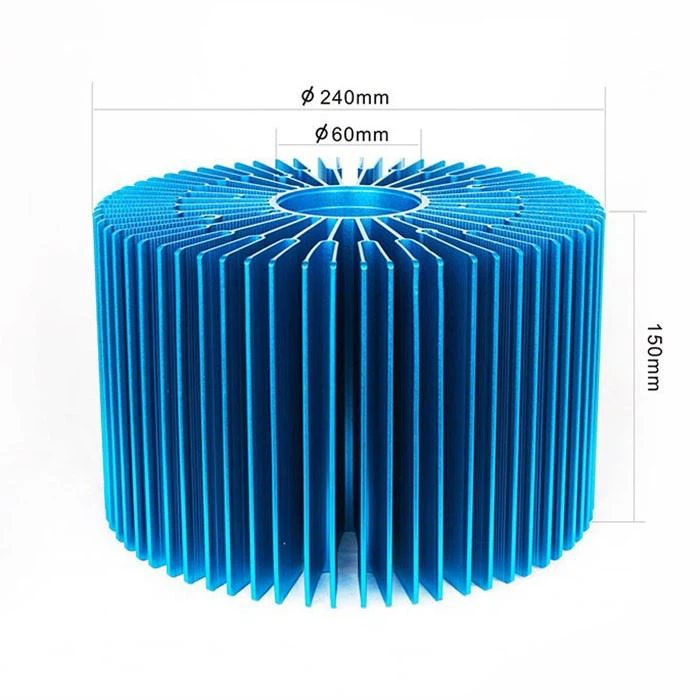
A cylindrical aluminum heat sink is a round-profile thermal management component designed to dissipate heat from high-power electronic systems.
Unlike flat or rectangular heat sinks, cylindrical designs provide:
- 360-degree heat dissipation
- Improved airflow distribution
- Compact installation structure
- Higher fin density
- Better thermal symmetry
These features make them especially suitable for systems where space is limited and thermal load is high.
Typical designs include:
- Radial fin heat sinks
- Circular extrusion heat sinks
- Hollow-core cylindrical profiles
- Integrated mounting structures
Most cylindrical heat sinks are manufactured through aluminum heat sink extrusion, which allows precise fin structures and high-volume production efficiency.
Why Aluminum Is the Preferred Material for Heat Sinks
Aluminum is the most widely used material for industrial heat sink applications.
Compared with steel, copper, or composite materials, aluminum offers the best balance between performance and cost.
1. Excellent Thermal Conductivity
Aluminum transfers heat efficiently from the source to the surrounding air.
This is critical in:
- Inverters
- IGBT modules
- Motor drives
- Power supplies
2. Lightweight Performance
In EV systems and industrial equipment, weight reduction improves efficiency and installation flexibility.
3. Corrosion Resistance
Aluminum performs well in outdoor and industrial environments, especially after anodizing.
4. Strong Extrudability
Complex fin structures can be produced through a single extrusion process.
5. Cost Efficiency
Compared with copper, aluminum provides better large-scale manufacturing economics.
This is why most professional aluminum extrusion manufacturers recommend aluminum for custom heat sink projects.
6061 vs 6063 Aluminum Heat Sink: What Is the Difference?
Among all aluminum alloys, 6061 and 6063 are the most common choices.
Although both belong to the 6000 series, they serve different engineering purposes.
6063 Aluminum Heat Sink
6063 is often called the architectural alloy, but it is also one of the best choices for precision heat sink extrusion.
Key Advantages
- Excellent extrusion performance
- Superior surface finish
- Better anodizing quality
- Ideal for thin fins and complex profiles
- Good corrosion resistance
Best Applications
- LED lighting systems
- Solar inverter cooling
- Industrial automation
- Power supply modules
- Communication equipment
Why Engineers Choose 6063
When fin density and surface quality matter more than extreme mechanical strength, 6063 is often the best solution.
6061 Aluminum Heat Sink
6061 is known for higher strength and stronger structural performance.
Key Advantages
- Higher tensile strength
- Better mechanical stability
- Stronger load-bearing capability
- Excellent machining performance
Best Applications
- EV battery systems
- Motor drive systems
- Heavy-duty power electronics
- Industrial machinery
- Structural thermal systems
Why Engineers Choose 6061
When both thermal management and mechanical strength are required, 6061 becomes the preferred alloy.
Which Alloy Is Better for Cylindrical Aluminum Heat Sink Applications?
The answer depends on application requirements.
Choose 6063 If:
- Heat dissipation is the top priority
- Fin geometry is complex
- Surface finish matters
- Anodizing is required
- Lightweight systems are preferred
Choose 6061 If:
- Structural strength is critical
- Mechanical stress is high
- Machining requirements are extensive
- Industrial durability is a priority
There is no universal answer.
The best alloy depends on engineering goals.
Typical Applications of Cylindrical Aluminum Heat Sink
Power Electronics
Applications include:
- IGBT modules
- Frequency converters
- Power supplies
- Industrial controllers
Thermal failure directly affects system reliability.
Renewable Energy Systems
Widely used in:
- Solar inverters
- Energy storage systems
- EV charging stations
Thermal efficiency improves overall energy performance.
LED Lighting
Round radial heat sinks are commonly used in:
- High-power LED lamps
- Industrial lighting systems
- Outdoor lighting
EV and Automotive
Used in:
- Battery cooling systems
- Onboard chargers
- Motor controllers
Compact thermal management is critical in EV platforms.
Why Cylindrical Design Improves Thermal Performance
Compared with flat profiles, cylindrical heat sinks provide several engineering advantages.
360° Heat Dissipation
Heat spreads evenly around the full structure.
Better Airflow
Radial fin geometry improves convection efficiency.
Compact Installation
Useful for limited enclosure space.
Higher Fin Density
More surface area improves cooling performance.
This is especially valuable in high-power compact systems.
Manufacturing Process of Aluminum Heat Sink Extrusion
Die Design
Precision die design determines:
- Fin shape
- Wall thickness
- Profile stability
Poor die design causes deformation and tolerance issues.
Extrusion Process
Critical variables include:
- Billet temperature
- Press speed
- Alloy behavior
Cooling and Straightening
Prevents:
- Profile warping
- Residual stress
- Dimensional instability
Surface Treatment
Common options:
- Anodizing
- CNC machining
- Brushing
- Powder coating
How an Aluminum Extrusion Manufacturer Supports Better Heat Sink Design
A professional aluminum extrusion manufacturer does more than produce profiles.
Engineering support includes:
Design Optimization
Reducing tooling cost and improving manufacturability.
Tolerance Control
Critical for:
- Assembly fit
- Thermal interface performance
- System stability
Alloy Recommendation
Selecting the best alloy based on:
- Power load
- Environmental conditions
- Structural requirements
Prototype Validation
Reducing risk before mass production.
Early collaboration saves both time and cost.
Common Design Mistakes in Heat Sink Projects
Too Many Fins
Higher density is not always better.
Poor airflow can reduce performance.
Wrong Alloy Selection
Choosing 6061 instead of 6063—or vice versa—can increase cost unnecessarily.
Ignoring Surface Treatment
Anodizing affects corrosion resistance and appearance.
Over-Specified Tolerances
This increases cost without improving functionality.
Engineering balance is the key.
Future Trends in Cylindrical Heat Sink Design
EV Growth
Battery and charging systems require better thermal solutions.
Higher Power Density
More power in smaller spaces increases cooling demands.
Renewable Energy Expansion
Solar and ESS systems need long-life heat sink structures.
Smart Manufacturing
Simulation-driven extrusion design improves performance and precision.
Choosing the right alloy for a cylindrical aluminum heat sink directly affects system performance, manufacturing cost, and long-term reliability.
- Choose 6063 for better extrusion quality and thermal efficiency
- Choose 6061 for higher structural strength and demanding industrial environments
The best solution depends on your application—not just the material itself.
Working with an experienced aluminum extrusion manufacturer ensures that heat sink design, alloy selection, and manufacturing feasibility are aligned from the beginning.
For industrial power systems, thermal management should never be treated as an afterthought.
It should be engineered from the start.
Shijun Hongmao Aluminum has over 20 years experience of manufacturing the industry aluminum profiles.
If you have any questions about our profiles, please feel free to leave a message.
aluminum heat sink for power electronics