
Industrial Aluminum Extrusion Profiles for Engineering & Project Manufacturing
- By:SJHM
- Date:23-01-2026
In today’s global manufacturing and infrastructure landscape, industrial aluminum extrusion profiles play a critical role across a wide range of industries. From industrial machinery and automation systems to construction, renewable energy, transportation, and electronic equipment, aluminum extrusion profiles have become a foundational material for modern engineering design.
Engineers and sourcing professionals increasingly rely on aluminum extrusion profiles to balance structural performance, durability, manufacturability, and cost efficiency. Unlike standardized components, industrial aluminum extrusion profiles are often deeply integrated into mechanical systems, meaning their design, production process, and dimensional stability directly influence assembly efficiency, system reliability, and long-term operational performance.
This article is written from the perspective of an industrial aluminum extrusion manufacturer with a strong focus on engineering applications. Rather than promoting products, the purpose is to share how aluminum extrusion profiles are designed, manufactured, processed, and applied in real-world projects—and why manufacturing experience and process control are often just as important as drawings and material specifications.
The content is structured around the core questions that engineers and procurement teams typically consider when evaluating a long-term aluminum extrusion partner.
Who We Are: An Engineering-Oriented Industrial Aluminum Extrusion Manufacturer
As an industrial aluminum extrusion manufacturer, our role extends far beyond producing aluminum profiles according to drawings. We focus on manufacturing aluminum extrusion profiles as functional components within engineered systems. This distinction is important because industrial aluminum extrusion profiles are rarely used in isolation; they are part of larger assemblies where dimensional accuracy, consistency, and compatibility with downstream processes are essential.
Our primary focus is on custom and semi-custom aluminum extrusion profiles designed to meet specific structural, dimensional, and environmental requirements. These profiles are developed for applications that demand predictable performance across production batches and project timelines.
Typical application areas for our industrial aluminum extrusion profiles include:
- Structural frames and load-bearing components for industrial machinery
- Modular systems and profiles for automation equipment
- Aluminum heat sink extrusion profiles for thermal management
- Architectural and engineering aluminum extrusion profiles
- CNC-machined aluminum extrusion components for precision assemblies
Rather than treating extrusion, machining, and surface finishing as separate processes, we approach aluminum extrusion manufacturing as a fully integrated production system. This perspective is shaped by long-term collaboration with engineering teams and project-based buyers who require not only parts, but manufacturing consistency and technical reliability.
For engineers, this means working with a manufacturer that understands how material behavior, profile geometry, and processing methods affect real-world performance. For procurement professionals, it means reduced risk, clearer communication, and greater confidence in repeat orders and long-term supply stability.
What Makes Industrial Aluminum Extrusion Profiles Different from Standard Profiles
Moving Beyond Standard Aluminum Extrusion Profiles
Standard aluminum extrusion profiles serve an important role in many applications, especially where flexibility and availability are prioritized. However, as systems become more complex and performance requirements increase, standard profiles often introduce compromises in weight optimization, structural efficiency, assembly complexity, or spatial constraints.
Industrial aluminum extrusion profiles are increasingly designed with application-specific functionality in mind. This approach allows engineers to integrate multiple features into a single profile, reducing the need for secondary components and simplifying assembly.
Common design considerations include:
- Integrating fastening channels, grooves, and alignment features directly into the profile cross-section
- Reducing or eliminating welded assemblies by using optimized extrusion geometry
- Designing profiles that support efficient CNC machining and post-processing
When aluminum extrusion profiles are designed with their end-use environment in mind, engineering teams gain greater control over system performance, while procurement teams benefit from more predictable manufacturing outcomes.
Long-Length Aluminum Extrusion Profiles: Practical Manufacturing Considerations
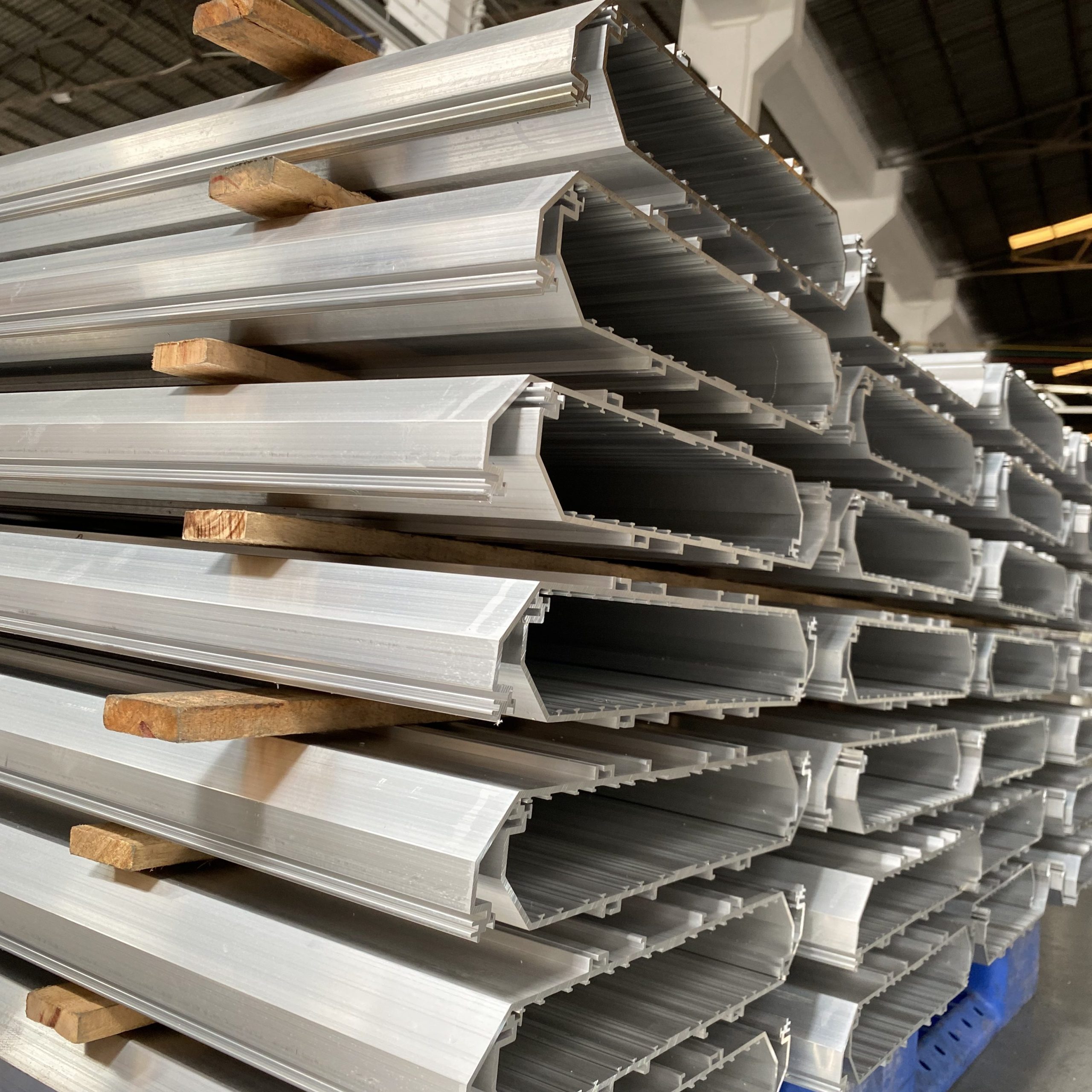
In industrial applications, long-length aluminum extrusion profiles often reveal the true capabilities of a manufacturer. Profiles used for machine frames, linear guides, conveyors, and structural systems typically demand strict control over straightness, dimensional tolerance, and mechanical stability.
From an engineering perspective, even minor deviations in long aluminum extrusion profiles can be amplified during assembly, leading to alignment issues, increased installation time, and potential rework. From a procurement standpoint, long-length profiles introduce additional challenges related to packaging, transportation, handling, and damage prevention.
Key manufacturing considerations for long-length industrial aluminum extrusion profiles include:
- Straightness control during the extrusion and cooling process
- Consistency in length and cross-sectional dimensions
- Stress management to prevent deformation during machining and transport
- Customized packaging solutions to protect profiles during logistics
These factors are rarely visible in basic technical datasheets, yet they have a direct impact on project execution, installation efficiency, and overall system quality.
Aluminum Alloy Selection for Industrial Aluminum Extrusion Profiles
Selecting the appropriate aluminum alloy is a critical decision in industrial aluminum extrusion projects. Material choice affects not only mechanical performance, but also extrusion feasibility, surface quality, machining behavior, and long-term reliability.
6063 Aluminum Extrusion Profiles
6063 aluminum is one of the most widely used alloys for aluminum extrusion profiles due to its excellent extrusion characteristics, stable forming behavior, and superior surface finish. It is particularly well-suited for complex cross-sections and applications where appearance and dimensional consistency are important.
For engineers, 6063 aluminum extrusion profiles offer greater design flexibility, allowing for intricate geometries without compromising manufacturability. For procurement teams, 6063 often translates into higher process stability and better batch-to-batch consistency, which is essential for long-term or repeat projects.
Typical applications of 6063 aluminum extrusion profiles include:
- Automation system frames
- Architectural aluminum extrusion profiles
- Heat sink aluminum extrusion profiles
- Decorative and exposed structural components
6061 Aluminum Extrusion Profiles
When higher structural strength is required, 6061 aluminum extrusion profiles are often selected. Compared to 6063, 6061 offers superior mechanical properties, making it suitable for load-bearing and high-stress applications.
However, 6061 aluminum extrusion presents additional challenges in extrusion control, surface quality, and CNC machining. Choosing 6061 is not simply an upgrade in material strength—it represents a deliberate trade-off between performance, manufacturability, and processing complexity.
Understanding these trade-offs helps engineers design more realistic components and enables procurement teams to evaluate the true capabilities of an aluminum extrusion manufacturer.
Aluminum Heat Sink Extrusion Profiles: Beyond Cross-Section Design
When evaluating aluminum heat sink extrusion profiles, attention is often focused on fin count, surface area, or theoretical thermal performance. In real-world applications, however, effective heat dissipation depends on a broader set of factors.
Uniform fin thickness, profile straightness, and dimensional consistency all influence airflow behavior and thermal conduction. Additionally, surface treatment compatibility and dimensional stability across production batches are critical for long-term reliability, particularly in high-temperature or outdoor environments.
By carefully controlling extrusion parameters, cooling methods, and post-processing techniques, aluminum heat sink extrusion profiles can deliver stable and predictable thermal performance throughout their service life.
CNC Machining of Industrial Aluminum Extrusion Profiles
CNC machining is often viewed as a secondary operation in aluminum extrusion manufacturing, yet its impact on final assembly quality is frequently underestimated.
For engineers, machining accuracy directly affects hole alignment, flatness, and edge quality, which in turn determine assembly precision and structural integrity. For procurement teams, integrating extrusion and CNC machining within a single manufacturing system reduces communication complexity, shortens lead times, and minimizes variability.
In project-based manufacturing, integrated CNC machining capability is a key factor in achieving reliable delivery schedules and consistent product quality.
Quality Management and Process Control in Aluminum Extrusion Manufacturing
The quality of industrial aluminum extrusion profiles is not defined solely by certifications or inspection reports, but by whether manufacturing processes are repeatable, traceable, and controllable.
Critical quality control measures include:
- Material traceability from aluminum billet to finished extrusion profile
- Multi-stage dimensional inspection throughout the production process
- Surface quality monitoring before and after finishing operations
- Documented process parameters for repeat and long-term orders
These practices provide engineers with predictable performance characteristics and help procurement teams reduce risks associated with batch variation and supply inconsistency.
How These Differences Are Demonstrated in Real Projects
The practical differences in our approach to industrial aluminum extrusion profiles become evident through long-term collaboration with engineering and procurement teams. Regardless of project scale, several guiding principles remain consistent:
- Manufacturing realities are considered during the design phase
- Production decisions are driven by application requirements, not short-term optimization
- Consistency and repeatability are prioritized over isolated cost reductions
By focusing on the complete lifecycle of aluminum extrusion profiles, from design and manufacturing to installation and operation, we support more efficient project execution and long-term system reliability.
Supporting Global Project Manufacturing and Infrastructure Development
Cross-border projects often involve multiple standards, complex logistics, and diverse operating environments. These challenges place higher demands on industrial aluminum extrusion manufacturers.
Through close coordination with project stakeholders, aluminum extrusion profiles can be not only manufactured, but delivered correctly and integrated smoothly, supporting project timelines and long-term operational goals.
Industrial aluminum extrusion profiles are fundamental building blocks in modern engineering systems. Their performance depends not only on alloy selection and cross-sectional design, but also on whether extrusion, machining, and quality control are treated as an integrated manufacturing process.
For engineers and sourcing professionals, understanding a manufacturer’s philosophy—who they are, how they work, and how their approach is demonstrated in practice—provides a more reliable basis for selecting a long-term aluminum extrusion partner.
When design intent and manufacturing reality are aligned, industrial aluminum extrusion profiles can truly support efficient assembly, stable operation, and successful project outcomes.
Learn More:https://www.sjhmalu.com/product