
How to Choose the Right Aluminium for Trailer Guard Frame Applications
- By:SJHM
- Date:20-05-2026
In modern transportation and trailer manufacturing, weight reduction, structural reliability, and long-term durability have become increasingly important. This is especially true for trailer guard systems, where aluminium profiles are now widely used to replace heavier steel structures in many applications.
How to choose the right aluminium profile for a trailer guard frame?
Choosing the right aluminium for trailer guard frame projects involves much more than selecting a profile shape or comparing raw material prices. For engineers, the decision affects structural behavior, manufacturability, corrosion resistance, and long-term maintenance. For procurement teams, it also affects production consistency, logistics efficiency, and the total lifecycle cost of the project.
In practice, successful trailer guard frame systems are usually the result of a combination of material selection, extrusion capability, machining precision, and surface finishing control rather than any single manufacturing step.
This article explores the key considerations involved in selecting aluminium profiles for trailer guard frames from both engineering and manufacturing perspectives.
Why Aluminium Is Widely Used for Trailer Guard Frames
Compared with traditional steel structures, aluminium extrusion profiles offer several advantages for trailer and transport applications.
These include:
- reduced overall vehicle weight
- improved corrosion resistance
- easier handling during assembly
- better design flexibility for structural profiles
- improved fuel efficiency through weight reduction
In trailer side guard systems and structural protection components, aluminium profiles are commonly used because they provide a balance between strength, durability, and manufacturability.
For many manufacturers, the challenge is not whether aluminium should be used, but which type of aluminium profile and manufacturing process will provide the most stable long-term performance.
Understanding the Functional Requirements of Trailer Guard Frames
Before selecting materials or profile designs, it is important to understand the actual functional requirements of the trailer guard system.
Depending on the application, trailer guard frames may need to address:
- side impact protection
- structural reinforcement
- vibration resistance
- outdoor weather exposure
- corrosion from road salt and moisture
- long-span dimensional stability
- lightweight transportation requirements
These operating conditions influence not only the alloy selection but also extrusion design, machining requirements, and surface finishing choices.
In many cases, profiles that perform well in laboratory conditions may behave differently after long-distance transportation, repeated loading cycles, or outdoor exposure.
This is why engineering considerations should begin early in the design and sourcing process.
Alloy Selection for Aluminium Trailer Guard Frames
One of the most important decisions in selecting aluminium for trailer guard frame applications is alloy selection.
Different aluminium alloys offer different balances between strength, extrusion performance, corrosion resistance, and surface quality.
6063 Aluminium Extrusion for Trailer Guard Systems
6063 aluminium extrusion is commonly used for structural and visible aluminium profiles because of its:
- stable extrusion behavior
- good surface quality
- excellent corrosion resistance
- suitability for complex cross-sections
For trailer guard frame applications involving long profiles or visible surfaces, 6063 often provides advantages in manufacturing consistency and surface appearance.
From an engineering perspective, 6063 allows greater flexibility in profile design while maintaining good dimensional control.
For manufacturing teams, the material’s stable flow characteristics during extrusion can help reduce deformation risks and improve profile straightness.
This becomes especially important for long-length aluminium trailer components.
6061 Aluminium Extrusion for Higher Structural Strength
In applications where higher mechanical performance is required, 6061 aluminium extrusion is often selected.
Compared with 6063, 6061 provides:
- higher tensile strength
- improved structural performance
- better load-bearing capability
However, these advantages also introduce additional manufacturing considerations.
6061 typically creates:
- higher extrusion resistance
- increased process sensitivity
- greater machining challenges
- more complex dimensional control requirements
As a result, choosing 6061 is not simply upgrading material strength. It involves balancing structural performance with manufacturing feasibility and consistency.
For projects involving complex machining or tight assembly tolerances, extrusion process control becomes particularly important.
The Importance of Extrusion Tolerance in Trailer Guard Frames
In many trailer projects, extrusion tolerance has a greater impact on final assembly quality than initial material cost.
Even small dimensional deviations can create:
- alignment issues during installation
- inconsistent mounting positions
- increased assembly time
- additional machining adjustments
- structural instability across long spans
This is particularly relevant for long aluminium profiles used in trailer side guard systems.
From a manufacturing perspective, extrusion tolerance is influenced by:
- die design
- alloy behavior
- extrusion temperature
- cooling control
- profile handling after extrusion
For procurement teams, inconsistent tolerances can lead to hidden costs that are not visible in quotations.
These costs often appear later during:
- assembly
- welding
- CNC machining
- surface finishing
- field installation
In many industrial aluminium extrusion projects, maintaining consistent tolerance across multiple production batches is often more important than achieving a single good sample.
Long-Length Aluminium Profiles and Structural Stability
Trailer guard systems frequently require long aluminium extrusion profiles.
Long-length profiles introduce additional manufacturing challenges including:
- profile straightness
- twisting control
- deformation during transportation
- surface damage during handling
Small variations become amplified over longer distances.
For engineers, this affects:
- structural alignment
- assembly precision
- installation efficiency
For procurement teams, long-length profiles also increase:
- packaging complexity
- transportation risks
- storage considerations
This is why manufacturing experience with long aluminium structural profiles becomes an important evaluation factor when selecting suppliers.
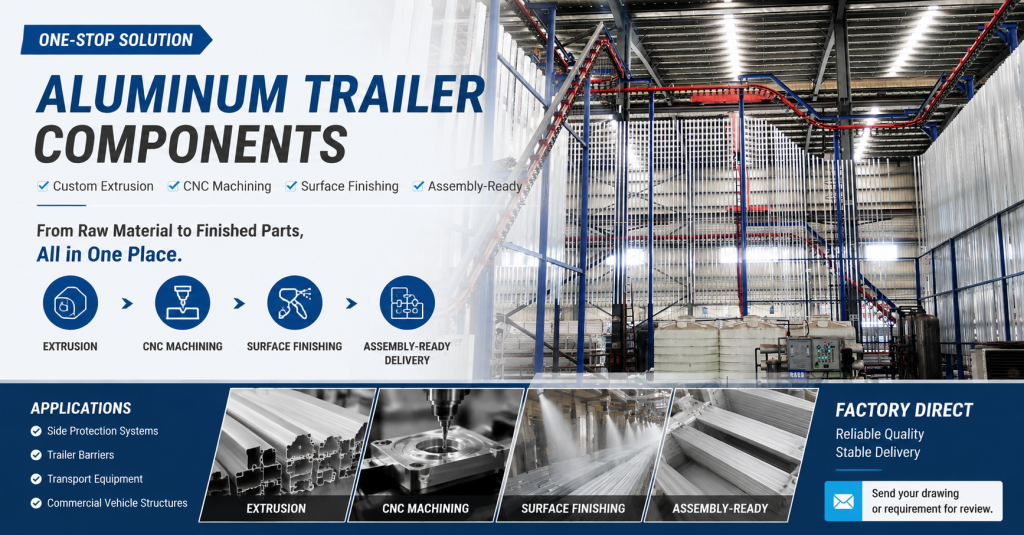
CNC Machining for Trailer Guard Components
Extrusion alone is rarely sufficient for complete trailer guard systems.
Most industrial trailer components also require CNC machining operations such as:
- drilling
- slotting
- mounting hole processing
- end machining
- structural connection preparation
From an engineering perspective, machining accuracy directly affects:
- assembly repeatability
- installation precision
- structural reliability
From a sourcing perspective, separating extrusion and machining across multiple suppliers may increase:
- communication complexity
- dimensional mismatch risks
- lead-time uncertainty
Integrating extrusion and machining within the same manufacturing system can help reduce these issues by improving process continuity and dimensional control.
In practice, machining stability is often closely connected to extrusion consistency.
Profiles with unstable dimensions or internal stress may create additional machining deformation or assembly variation later in production.
Surface Finishing for Aluminium Trailer Guard Frames
Surface finishing plays both functional and aesthetic roles in trailer applications.
Depending on the operating environment, surface treatments may be required for:
- corrosion resistance
- UV stability
- improved appearance
- environmental durability
- easier maintenance
Common finishing options include:
- anodizing
- powder coating
- electrophoretic coating
For trailer guard systems operating in outdoor or coastal environments, surface durability becomes especially important.
From a manufacturing perspective, surface quality is affected not only by coating itself, but also by:
- extrusion surface consistency
- profile cleanliness
- dimensional stability
- handling methods during finishing
In many projects, vertical powder coating lines are preferred for long aluminium profiles because they help:
- reduce contact marks
- improve coating consistency
- support more stable surface appearance across batches
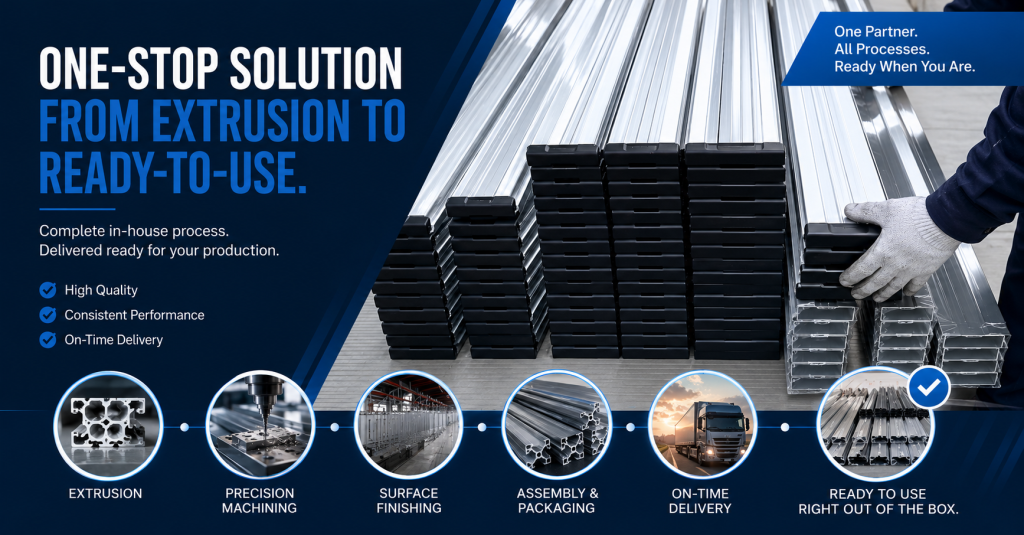
Why Integrated Manufacturing Matters
In trailer guard frame manufacturing, the difference between suppliers often appears not in individual processes, but in how well multiple processes are connected together.
Projects involving:
- extrusion
- CNC machining
- surface finishing
- packaging
- logistics
require coordination across the entire manufacturing flow.
When these processes are managed separately, risks may increase:
- dimensional variation between stages
- repeated handling damage
- communication delays
- inconsistent quality responsibility
An integrated manufacturing approach helps reduce these risks by improving process continuity.
For procurement teams, this can lead to:
- lower coordination costs
- more predictable lead times
- reduced rework
- simplified quality management
For engineers, it allows manufacturing decisions to align more closely with real application requirements.
The value of integration is often not visible in a quotation, but becomes increasingly important during production scaling and repeat orders.
Quality Control in Aluminium Trailer Guard Manufacturing
In industrial aluminium extrusion projects, quality management is not only about inspection reports or certifications.
More importantly, it involves whether manufacturing processes remain stable and repeatable over time.
Typical quality control areas include:
- raw material traceability
- extrusion dimensional inspection
- straightness monitoring
- machining precision verification
- surface finishing inspection
- batch consistency records
For long-term trailer manufacturing programs, repeatability often becomes more important than isolated production results.
This is especially true for OEM and fleet applications where consistency across multiple units is essential.
Engineering Considerations Beyond the Drawing
Technical drawings define dimensions and specifications, but many real manufacturing variables are not fully visible on paper.
These include:
- alloy flow behavior
- extrusion stress
- thermal expansion
- machining deformation
- coating interaction
- transportation handling risks
This is why early collaboration between engineering and manufacturing teams often improves project outcomes.
Profiles that appear simple in CAD models may become challenging during extrusion or assembly if manufacturing realities are not considered during design.
Understanding these limitations early helps reduce redesign, delays, and hidden project costs.
Aluminium for Trailer Guard Frame Applications in Global Markets
As transportation and logistics industries continue to evolve, trailer manufacturers increasingly require aluminium systems that combine:
- lower weight
- structural reliability
- stable manufacturing quality
- efficient assembly
- corrosion resistance
Aluminium extrusion suppliers are evaluated not only on pricing, but also on:
- manufacturing consistency
- project communication
- technical understanding
- long-term supply stability
As trailer systems become more complex and integrated, manufacturing capability increasingly becomes part of the engineering solution itself.
Choosing the right aluminium for trailer guard frame applications involves much more than selecting a profile or comparing material prices.
Successful trailer guard systems depend on the interaction between:
- alloy selection
- extrusion consistency
- machining precision
- surface finishing quality
- long-term manufacturing stability
For engineers, these factors affect structural reliability and installation performance.
For procurement teams, they influence production risk, lifecycle cost, and supply consistency.
In many projects, the true difference between suppliers becomes visible not during quotation, but during manufacturing, assembly, and long-term operation.
As industrial aluminium extrusion applications continue to expand in transportation systems, integrated manufacturing and process consistency will remain critical factors in achieving stable project performance over time.
Foshan Shijun Hongmao Aluminum,as a leading manufacturer specializing in custom industrial aluminum profiles, we offer precision-engineered solutions tailored to your specific needs.
Learn more:https://www.sjhmalu.com/