
What Makes Rail Transit Aluminum Profiles the Backbone of Modern Transportation Systems?
- By:SJHM
- Date:29-10-2025
Rail Transit Aluminum Profiles: The Aluminum Backbone
Speed is the soul of modern transportation. Rail Transit Aluminum Profiles, with their exceptional properties like high strength-to-weight ratio, corrosion resistance, and easy formability, have become the undisputed “backbone” of transportation guide rail systems. As a specialist industrial aluminum profile manufacturer with years of expertise, Shijun Hongmao Aluminum understands that the quality of Rail Transit Aluminum Profiles is directly critical to the entire system’s safety, stability, and service life. This article systematically deciphers Rail Transit Aluminum Profiles, covering core material science, wide-ranging applications, precise production process control, and our robust quality assurance system.
Rail Transit Aluminum Profiles: The Science of Material Selection
Material is the foundation. For Rail Transit Aluminum Profiles enduring high-frequency, high-load, and complex environmental challenges, material selection is paramount. Not all aluminum alloys are suitable; specific series of wrought aluminum alloys with precise alloy ratios and heat treatment are essential to meet stringent mechanical property requirements.
1.1 Primary Material Series: 6-Series Aluminum Alloys
Currently, Rail Transit Aluminum Profiles predominantly use 6-series alloys (Al-Mg-Si series), favored for their excellent extrudability, medium strength, good corrosion resistance, and superior weldability. Common grades include:
- 6005A Alloy: A “star” material for high-speed rail and metro vehicles. In T5 or T6 tempers, it achieves an excellent balance of strength (tensile strength typically >260 MPa) and hardness, with good fracture toughness and stress corrosion cracking resistance, fully complying with European standards like EN 755-9 and EN 13981-1.
- 6082 Alloy: A high-end alternative similar to 6005A. In T6 temper, its strength is often slightly higher, making it suitable for critical structural components. It also adheres strictly to international standards.
- 6061 & 6063 Alloys: More general-purpose 6-series alloys used in less demanding applications like station platform screen doors or pedestrian overpass rails, offering cost advantages.
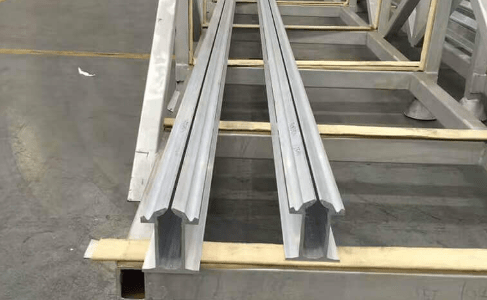
Shijun Hongmao Aluminum’s Material Selection:
We partner with top-tier aluminum ingot suppliers, ensuring all raw billets come with third-party composition analysis reports, guaranteeing elements like Mg, Si, Cu, Fe are precisely controlled from the source.
1.2 Material Selection Considerations
Selecting materials for Rail Transit Aluminum Profiles involves evaluating:
- Mechanical Properties: Tensile strength, yield strength, elongation, hardness.
- Extrudability: Affects the ability to produce complex, precise, smooth profiles.
- Corrosion Resistance: Vital for withstanding atmospheric exposure, rain, and de-icing salts.
- Weldability: Ensures welded joints match the base material’s strength.
- Cost-Effectiveness: Balancing performance requirements with budget.
Rail Transit Aluminum Profiles: Extensive Application Fields
The use of Rail Transit Aluminum Profiles extends far beyond traditional railways, integral to modern transportation networks. 2.1 Main Structure of Rail Vehicles Bodies, floors, sidewalls, and roofs of high-speed trains are primarily constructed from large, hollow, thin-walled 6005A or 6082 aluminum profiles, offering high strength and significant weight reduction.
2.2 Guidance and Load-Bearing Track Systems
- Maglev Train Track Beams: The guideway itself is a massive aluminum profile housing functional components.
- Monorail Track Beams: Use large aluminum profiles for guidance, load-bearing, and power transmission.
- Automated Warehouse (AS/RS) Guides: Precision aluminum guides enable high-speed, accurate movement.
2.3 Station and Auxiliary Facilities
- Platform Screen Doors: Frames and sliding rails are made from high-surface-quality aluminum profiles.
- Escalator and Elevator Guides: Provide precise guidance.
- Footbridges: Lightweight, quick to build, and weather-resistant.
2.4 Emerging Fields
- New Energy Bus Bodies: For weight reduction and extended range.
- Smart Logistics Lines: Aluminum guides are crucial in automated sorting and assembly lines.
Rail Transit Aluminum Profiles: Precision Production Process Control
Superior materials require superior manufacturing. We employ advanced equipment and strict process controls to ensure every meter of profile meets exact specifications.
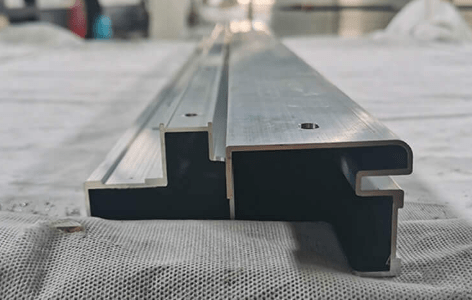
3.1 Mold Design & Manufacturing
Using CAD technology and premium imported steel, we design and manufacture durable, high-precision molds for optimal metal flow.
3.2 Extrusion Forming
- Heating Control: Billet heating is precise within ±3°C for uniform temperature.
- Extrusion Process: Large-tonnage presses (2000T-5500T) with controlled speed and temperature produce dense, fine-grained profiles.
3.3 Online Precision Quenching
Critical for achieving T5/T6 properties. Profiles are instantly and uniformly cooled using air or mist quenching after extrusion.
3.4 Stretching & Cutting
- Stretching: Corrects distortion and improves straightness.
- Cutting: Precision flying saws ensure length tolerance within ±1mm.
3.5 Aging Heat Treatment
Automated aging ovens (±3°C uniformity) strengthen profiles by precipitating hardening phases.
3.6 Surface Treatment
Options include:
- Anodizing: Hard, wear-resistant, corrosive-resistant oxide layer.
- Powder Coating: Aesthetic, colorful, excellent weather resistance.
- Electrophoretic Coating: Smooth, glossy, highly corrosion-resistant.
Comprehensive Quality Assurance System for Rail Transit Aluminum Profiles
Quality is our lifeline. Shijun Hongmao Aluminum implements a full-process quality assurance system for “zero-defect” products.
4.1 Incoming Quality Control (IQC)
Spectrometer analysis ensures chemical composition of billets; strict checks on auxiliary materials.
4.2 In-Process Quality Control (IPQC)
Inspectors continuously monitor:
- Dimensional Accuracy: Frequent checks with precision tools.
- Surface Quality: Visual inspection under dedicated lighting.
- Process Parameters: Logging key parameters like temperature and speed.
4.3 Final Quality Control (FQC/OQC)
Comprehensive pre-shipment checks:
- Mechanical Tests: Tensile tests on universal testing machines.
- Hardness Tests: Rapid non-destructive checks.
4.4 Certification System
We are certified under ISO 9001 Quality Management Systems, ensuring international standard compliance. If you are seeking high-quality aluminum profiles for your transportation project, contact us. Our engineers offer one-stop professional services from material selection to manufacturing.
Learn more:https://www.sjhmalu.com/product