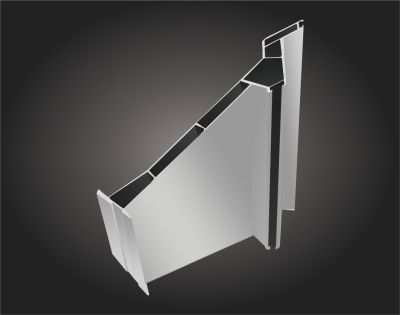
Why Choose Aluminum Profiles for Railway Vehicles? Six core advantages for railway vehicle aluminum profiles
- By:SJHM
- Date:08-10-2025
The preference for railway vehicle aluminum profiles in the rail transit sector stems from their irreplaceable comprehensive performance. This is concretely reflected in the following six core advantages that make railway vehicle aluminum profiles the top choice. These specific advantages highlight the critical role of railway vehicle aluminum profiles in modern train design.
railway vehicle aluminum profiles
- Exceptional Lightweighting Effect: The density of aluminum alloy is about 2.7g/cm³, only about one-third that of steel (7.85g/cm³). This allows for a 30%-40% reduction in vehicle body weight. This translates to significant energy consumption reduction (studies show that a 10% reduction in body weight can lower operating energy use by about 6-8%), improved traction and acceleration performance, and reduced wear on tracks, delivering substantial economic value throughout the entire lifecycle. This weight saving is a primary reason for using railway vehicle aluminum profiles.
- Outstanding Specific Strength and Rigidity: Lightweighting alone is insufficient for safety. Through rational alloy formulation, heat treatment, and innovative multi-chamber hollow structure design, railway vehicle aluminum profiles provide extremely high specific strength (strength/density) and rigidity, fully meeting and exceeding strict crash safety and operational stability standards. The strength of railway vehicle aluminum profiles is paramount.
- Excellent Corrosion Resistance: A dense layer of aluminum oxide naturally forms on the surface of aluminum, giving it strong resistance to atmospheric corrosion (including marine climates) and chemical corrosion (e.g., from de-icing salts). This not only significantly extends the vehicle’s service life by 20-30 years but also considerably reduces later-stage painting and maintenance costs. The durability of railway vehicle aluminum profiles ensures long-term performance.
- Superior Processability and Formability: Aluminum alloys, especially the 6000 series, possess excellent extrusion properties. They can be formed in one extrusion into thin-walled, large-section, hollow railway vehicle aluminum profiles with extremely complex structures. This enables integrated design of the car body structure, reduces the number of parts, simplifies the assembly process, and improves production efficiency and consistency. The manufacturability of railway vehicle aluminum profiles facilitates efficient production.
- Good Energy Absorption and Safety: In the event of an accidental collision, aluminum alloy can undergo controlled plastic deformation through its good toughness, effectively absorbing and dispersing huge impact energy, providing maximum protection for the passenger compartment, resulting in exceptionally high passive safety. The safety features of railway vehicle aluminum profiles are critical.
- Green, Eco-Friendly, and 100% Recyclable: Aluminum is a highly valuable renewable resource. Its recycling and reuse rate exceeds 95%, and the energy required for remelting and recycling is only 5% of that for primary production. This perfectly aligns with the global strategic direction of sustainable development and holds high environmental value. The recyclability of railway vehicle aluminum profiles underscores their sustainability.
railway vehicle aluminum profiles.
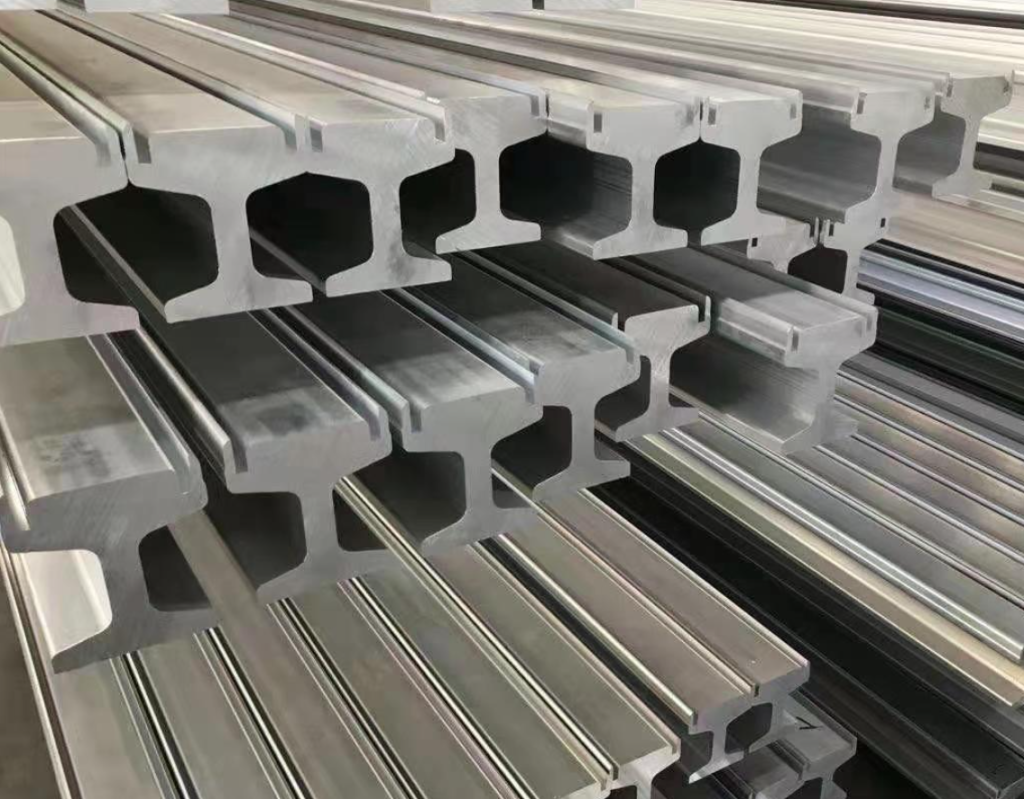
Railway vehicle aluminum profiles are not ordinary aluminum products; they have extremely stringent requirements for alloy composition, mechanical properties, and process performance. Currently, 6000 series (Al-Mg-Si) aluminum alloy is the absolute mainstream choice for manufacturing these high-performance railway vehicle aluminum profiles.
- 6005A: Can be called the “main force” in the European standard system and for Chinese high-speed rail. Its magnesium (Mg) and silicon (Si) element ratio is optimized, achieving the best balance between extrudability, weldability, corrosion resistance, and strength (typically in the T6 condition). It is the preferred material for manufacturing the main body structure of railway vehicles.
- 6082: Similar in performance to 6005A, also widely used in Europe, with high strength and good corrosion resistance.
- 6061: Used more in the North American and Japanese markets, with good overall performance and is an internationally universal standard alloy.
- 7xxx series (e.g., 7005, 7A04): Classified as super-hard aluminum, offering the highest strength but relatively poor weldability. Typically used for key load-bearing components like bolster beams and impact seats where strength requirements are extremely high but welding needs are relatively low.
Regarding Material Temper: Common T5 (air cooling + incomplete artificial aging) and T6 (water quenching + complete artificial aging) tempers determine the final properties of the railway vehicle aluminum profiles. The T6 condition yields higher strength and hardness and is the common choice for rail transit profiles. The manufacturing of railway vehicle aluminum profiles is a perfect combination of technology, equipment, and experience. The process is precise and complex, ensuring the quality of the final railway vehicle aluminum profiles.
- Die Design : Excellent die design requires simulation using Finite Element Analysis (FEA) to accurately predict metal flow, ensuring a smooth extrusion process and uniform flow velocity at all points of the profile cross-section, resulting in products with low internal stress and precise dimensions crucial for railway vehicle aluminum profiles.
- Extrusion Forming : Large extrusion presses of 10,000 tons or more are required. Heated aluminum billets are forced under immense pressure through a die with a specific profile to obtain the desired cross-sectional shape. Precise control of extrusion temperature, speed, and pressure is key to ensuring surface quality and microstructure properties for high-quality railway vehicle aluminum profiles.
- Heat Treatment : Mainly includes homogenization, online quenching, and artificial aging (T5/T6). This series of precise thermal processes controls the internal microstructure of the alloy, causing precipitation strengthening phases to form, thereby achieving the mechanical properties required by standards for reliable railway vehicle aluminum profiles.
- Precision Processing and Inspection – The Foundation of Quality:
- Stretching and Straightening: Eliminates longitudinal bending and twisting of the profiles.
- Precision Machining: Uses CNC machining centers to mill and drill the ends of the railway vehicle aluminum profiles, creating high-precision welding grooves and assembly interfaces.
- Comprehensive Inspection: Includes:
- Chemical Composition Analysis: Ensures raw material qualification.
- Mechanical Property Testing: Tensile testing using a universal testing machine validates the strength of the railway vehicle aluminum profiles.
- Dimensional Inspection: Full-dimensional scanning using a Coordinate Measuring Machine (CMM) checks the precision of the railway vehicle aluminum profiles.
- Non-Destructive Testing (NDT): Ultrasonic Testing (UT) is used for 100% scanning of the interior of the railway vehicle aluminum profiles to ensure the absence of cracks, pores, and other defects.
Producing large-section, thin-walled, high-performance railway vehicle aluminum profiles presents numerous technical challenges for manufacturers:
- Challenge 1: Extreme Control of Dimensional Accuracy. How to ensure that indicators like straightness and twist for profiles tens of meters long are stably controlled within ±1mm/m. This precision is essential for railway vehicle aluminum profiles.
- Challenge 2: Uniformity of Microstructure and Properties. How to ensure consistent mechanical properties from the head to the tail of the entire profile, avoiding performance fluctuations in the railway vehicle aluminum profiles.
- Countermeasure: This requires manufacturers to possess advanced process control capabilities, such as adopting isothermal extrusion technology, optimized die design, and precise quenching and cooling systems, specifically for producing high-grade railway vehicle aluminum profiles.
As a purchaser, how should you choose a reliable supplier for railway vehicle aluminum profiles? Faced with an important procurement decision, the following is a practical checklist focusing on suppliers of railway vehicle aluminum profiles:
- Qualifications and Certifications
- Technical Strength: R&D capability, successful project experience specifically with railway vehicle aluminum profiles.
- Equipment Level: Availability of large extrusion presses, advanced processing, and inspection equipment suitable for railway vehicle aluminum profiles.
- Quality System: A comprehensive, traceable quality control system for railway vehicle aluminum profiles.
- Service Capability: Technical support, project management, and after-sales service for railway vehicle aluminum profiles.
The development of railway vehicle aluminum profiles is an epitome of modern industrial civilization’s pursuit of efficiency, energy saving, and safety. Choosing a technically proficient, quality-stable, and professionally serviced partner for railway vehicle aluminum profiles is crucial for project success.
- Shijun Hongmao Aluminum, as a leading industrial aluminum profile manufacturer in China, has multiple precision aluminum extrusion production lines including 600, 1000, 1800, 2500, 3600, 5000, 6000, 10000, 12500, and 20000-ton capacities, enabling the production of a wide range of railway vehicle aluminum profiles.
- We can produce flat products within 950mm x 450mm, aluminum square tubes within 450mm x 450mm, and aluminum round tubes within Φ600mm, catering to various specifications for railway vehicle aluminum profiles.
- We have over 60 advanced precision CNC deep processing equipment, double traction extrusion equipment, high-precision CNC milling machines, 6.5-meter-long profile processing centers, and more, supporting the complex manufacturing needs of railway vehicle aluminum profiles.
Learn more :http://www.sjhmalu.com